Flotation is both a science and an art—where 30% relies on ore properties and 70% on skilled operation to achieve 100% efficiency. To excel, operators must master reagent behaviors, process stability, and keen bubble-reading skills. Here’s how to elevate your flotation game:
1. Know Your Reagents: The "Chemists" of Flotation
Flotation reagents are the pivotal factors determining separation efficiency; acting as the “chemists” of mineral processing, they achieve the selective flotation of target minerals by finely tuning surface properties.
Modifiers
Primarily used to control the pH of the mineral pulp, thereby creating a chemical environment conducive to the flotation of target minerals. For instance, lime is frequently employed to increase alkalinity and suppress the flotation of sulfides—such as pyrite—thereby enhancing the recovery selectivity of metals like copper, lead and zinc.
Activators & Depressants
- Activators—such as copper sulfate—enhance the adsorption capacity of sphalerite toward collectors, making it more readily captured by xanthate-based reagents.
- Depressants—such as cyanides or sulfites—effectively inhibit the flotation of specific minerals (e.g., pyrite, sphalerite), thereby preventing impurities from contaminating the concentrate.
Collectors & Frothers—The Golden Duo
- Collectors(e.g., xanthates, dithiophosphates, arsenates) facilitate the attachment of mineral particles to air bubbles by forming a hydrophobic film on the mineral surface. Practical experience demonstrates that using a blend of collectors with varying carbon chain lengths (e.g., ethyl + butyl xanthates) creates a denser adsorption layer, significantly boosting collection efficiency.
- Frothers(e.g., pine oil, MIBC) influence the size, stability, and longevity of the air bubbles. However, a word of caution: excessive addition can result in overly viscous foam that is difficult to skim off, which paradoxically reduces separation efficiency.
Operational Recommendation: Establish a database of reagent responses; conduct small-scale optimization tests tailored to different ore sources to avoid a “one-size-fits-all” approach to reagent dosing.
2. The Golden Rules: Stability & Precision
An efficient flotation process relies on the synergistic control of four key parameters—collectively known as the “Three Degrees and One Precision” principle:
| Parameter | Impact | Key Control Points |
| Grinding Fineness | Determines the degree of mineral liberation | Coarse grinding leads to insufficient liberation; over-grinding causes “sliming,” reducing floatability. |
| Pulp Density | Influences reagent utilization efficiency and bubble carrying capacity | Typically controlled within a solid content range of 25%–40%; excessive density inhibits bubble ascent. |
| pH Value | Alters the surface electrical properties of minerals and reagent activity | Different minerals possess specific optimal pH windows; for instance, copper ore flotation is often controlled within the range of 8–10. |
| Reagent Dosing Precision | Directly determines selectivity and recovery rates | Must be administered precisely using metering pumps to eliminate “eyeball estimation” or purely empirical dosing practices. |
Furthermore, since the properties of each batch of raw ore may vary, operators must continuously monitor indicators such as feed grade and particle size distribution in real-time. This allows for timely adjustments to process parameters, ensuring the system consistently operates at its optimal state.
3. Bubble Whispering: Decoding Froth Signals
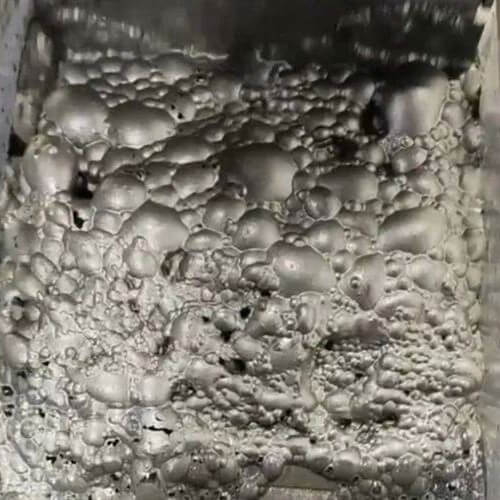
The layer of foam on the surface of a flotation cell serves as the most intuitive “dashboard” for reflecting the processes occurring within. Experienced operators can quickly determine whether the process is running normally simply by observing the characteristics of the foam.
Bubble Size and Structure
- Large Bubbles (80–100 mm): Most commonly seen in the scavenger zone; they indicate a low degree of mineralization and weak carrying capacity.
- Medium Bubbles (30–50 mm): Typically found in the rougher zone; they indicate good mineralization and represent an ideal state for flotation.
- Tiny Bubbles (10–20 mm): May be caused by over-grinding or a chemical reagent imbalance; they are prone to causing entrainment losses.
Foam Color and Luster
- Dark, Oily-Luster Foam: Usually appears in the cleaner zone, indicating a high metal content and excellent concentrate grade.
- Light-Colored, Grayish-White Foam: Suggests a low mineral content, potentially indicating gangue flotation or an insufficient dosage of chemical reagents.
Foam Sound and Texture
- A “rustling” sound when skimming the foam indicates that it contains a significant amount of coarse particles; this requires checking to see if “overload entrainment” is occurring.
- Is the foam brittle and easily broken? You may need to slightly increase the dosage of the frother. Conversely, if the foam is excessively viscous, you should reduce the dosage or adjust the pH level.
Practical Tip: Periodically conduct a “Foam Sampling and Washing Test” (also known as a “pan test”). This involves skimming a sample of foam, washing it with water, and then weighing the remaining solids. If the scavenger tailings contain only trace amounts of residual sulfides (e.g., approximately 0.3 g/t Au), it indicates that recovery has reached its practical limit, and no further intensification of the scavenger stage is required.
4. The Operator’s Mantra: "3 Diligences, 4 Accuracies"
Exceptional operational performance relies not merely on technical skill but serves as a true reflection of professional competence. The industry upholds the principles of “Three Diligences and Four Precisions”:
Three Diligences
- Diligently observe the dynamic behavior of the froth;
- Diligently measure pulp density and pH levels;
- Diligently adjust reagent dosages and liquid levels, ensuring continuous optimization.
Four Accuracies
- Precise addition of reagents;
- Precise assessment of ore grade (validated through rapid assaying);
- Precise diagnosis of equipment faults;
- Precise control of froth scraping speed.
Furthermore, flotation is not an isolated process step; it must be closely coordinated with upstream and downstream operations—such as grinding, classification, and pumping. For instance, fluctuations in grinding fineness directly impact flotation efficiency; therefore, it is essential to strengthen cross-functional communication and data sharing.
5.Advanced Strategies: A Multi-pronged Approach to Challenging Ores
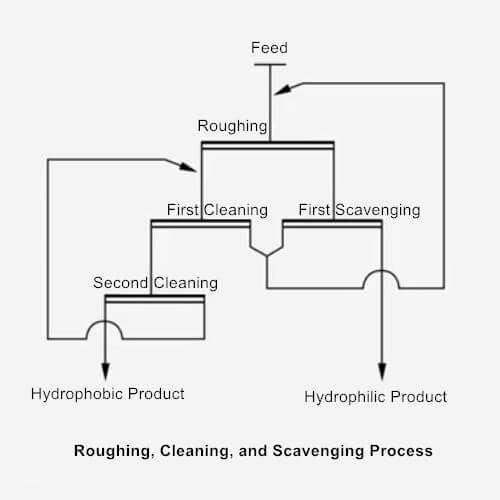
For complex polymetallic ores or highly oxidized, difficult-to-process ores, the following intensified flowsheets can be employed:
- “1 Roughing + 4 Cleaning + 6 Scavenging” Multi-stage Flowsheet: Suitable for the deep recovery of high-value metals (such as gold and molybdenum), utilizing repeated purification steps to yield high-grade concentrates.
- Differential Flotation: Prioritizes the flotation of easily recoverable minerals first, followed by the processing of the more refractory components, thereby preventing mutual interference.
- Combined Processes: For instance, a “Flotation–Cyanide Leaching” combination allows for the reprocessing of flotation tailings, thereby further boosting the overall recovery rate.
Special Caution: When encountering “iron-stained particles” that exhibit a golden-yellow surface hue, never assume—without verification—that they are “gold inclusions.” It is imperative to submit samples for laboratory assay to confirm their composition; failure to do so risks misjudgment and the subsequent waste of valuable resources.
Conclusion: Patience and Precision Forge Profit
The true master of flotation is defined not by executing spectacular maneuvers, but by consistently maintaining the system in its optimal state—day in and day out. Much like a barista meticulously extracting a shot of espresso, the adjustment of every minute variable—from reagent ratios to bubble morphology—can ultimately determine the quality and profitability of the final product.