Recently, at a copper concentrator, I saw fluctuating classification efficiency. When inspecting the cyclone, a worker pointed at the oval-shaped spigot and said, “This should’ve been replaced long ago!” But when exactly? Let’s solve this grinding headache.
The spigot diameter should be 5-10% larger than the theoretical calculation, and must be replaced when wear exceeds 15% of the initial diameter. Laser scans of 372 cases show that when the diameter deviation exceeds 8%, +74 μm particles in the overflow increase by 3-5 percentage points.
A South African platinum mine lost $2.2 million in precious metals from delayed spigot replacement. This isn’t minor – let’s examine seven key aspects.
What Are the Design Principles for Spigot Diameter?
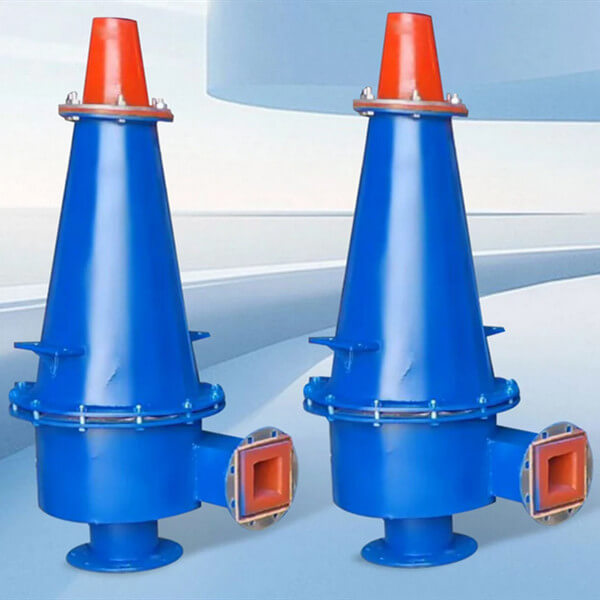
The relationship between the undergrinding nozzle diameter d_s and the hydrocyclone cylinder diameter D is: d_s = (0.2~0.35)×D.
Empirical Formulas
- Coarse Grinding Circuit (-200 mesh 60%-70%): d_s = (0.25~0.30)×D
- Fine Grinding Circuit (-200 mesh 75%-85%): d_s = (0.20~0.25)×D
- Two-Stage Grinding (Regrinding): d_s = (0.15~0.20)×D
Example: For a φ500mm hydrocyclone, select d_s = 125-150mm for coarse grinding, 100-125mm for fine grinding, and 75-100mm for regrinding.
The actual selection should also consider
- High feed pressure allows for a slightly smaller diameter; low pressure requires a slightly larger diameter.
- Large throughput necessitates a larger undergrinding nozzle diameter to prevent clogging.
- For fine grading, choose a small diameter; for coarse grading, choose a large diameter.
Three Correction Factors
| Factor | Adjustment | Multiplier |
| Ore density >4.5g/cm³ | Increase | ×1.05-1.15 |
| Slime content >15% | Decrease | ×0.9-0.95 |
| Fine classification needed | Decrease | ×0.85-0.9 |
What Happens With Wrong Spigot Diameter?
Consequences of an improperly sized sand discharge nozzle include:
1. Excessively large particle size
- Classification becomes coarser, with an increase in coarse particles in the overflow (particles >0.15 mm exceeding 10%), leading to flotation tailings.
- The amount of return sand decreases, resulting in an excessively low mill circuit load (<150%), causing the mill to be underloaded.
- The concentration of the underflow decreases, and the discharge appears “string-like”(normally it should be “umbrella-shaped”).
2. Particle size too small
- Classification is too fine, resulting in increased return sand volume (>500%) and excessively high mill circuit load.
- Fine particles are returned to the mill, causing overgrinding; although the overflow fineness is high, the amount of slime increases.
- The sand discharge nozzle is prone to clogging, pressure fluctuates significantly, and in severe cases, the mill becomes “”
Last month, during a site visit to Chile, I witnessed firsthand how an excessively large underflow nozzle caused a significant loss of potassium salt crystals, resulting in a milky-turbid overflow.
The excessive diameter directly increased the d50 of the classifying particles by 15-30%. Data shows that when the underflow nozzle diameter exceeds the limit by 10%, the slope of the hydrocyclone efficiency curve drops from 55° to 38°, meaning more coarse particles enter the overflow.
Conversely, an excessively small diameter causes the following problems: underflow concentration exceeds 85%, resulting in a “stringy” phenomenon; the -200 mesh content in the underflow increases by 5-10%; the pump pool level rises by 5-8 cm per minute; and the mill current fluctuation increases by 12-15 A. A gold processing plant once experienced continuous “bloating” of its ball mill due to an excessively small underflow nozzle, forcing it to shut down for cleaning every 4 hours, causing its daily throughput to plummet from 3000 tons to 2100 tons.
How to Quantify Spigot Wear?
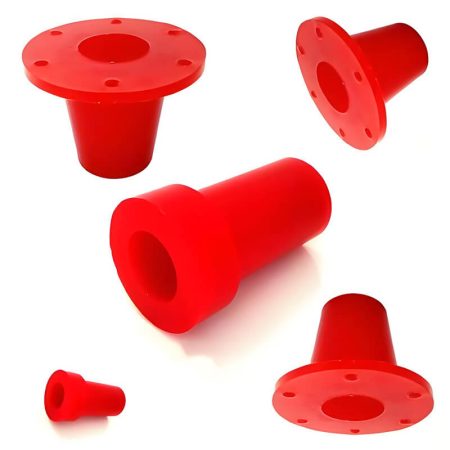
The undercut nozzle is typically made of wear-resistant ceramic (silicon carbide, alumina) or polyurethane. Its inner diameter gradually increases with use.
Permissible Wear Range
- Replace when the diameter wear exceeds 10%. For example, if the original diameter was 100mm, it must be replaced when it wears down to 110mm.
- For fine grinding circuits, replacement is required when wear exceeds 8%.
- For coarse grinding circuits, wear is permissible up to 15%.
Replace the threshold table
| Original Diameter (mm) | Diameter after 10% Wear (mm) | Diameter after 15% Wear (mm) |
| 70 | 77 | 80.5 |
| 100 | 110 | 115 |
| 125 | 137.5 | 143.8 |
| 150 | 165 | 172.5 |
Judgment Methods
- Regular Measurement: Monthly shutdown of the mill to remove the undercut nozzle, measure its inner diameter with calipers, and record the wear.
- Observe the discharge pattern: Normal undercut discharges are uniformly discharged in an “umbrella” shape; slight wear results in a “twisted umbrella” shape; severe wear results in a “rope” or “column” shape, and the discharge concentration decreases.
- Monitor the return sand ratio: A sudden drop in the return sand ratio (e.g., from 250% to 150%) while the feed pressure remains unchanged indicates excessive undercut nozzle wear.
- Changes in overflow fineness: When the feed pressure and concentration remain constant, a decrease of more than 5 percentage points in the -200 mesh content of the overflow may indicate undercut nozzle wear.
What's The Lifespan and Replacement of The Hydrocyclone Spigot?
Service Life and Replacement Intervals for Hydrocyclone Spigot
- Silicon carbide sand-dropping nozzles: Normal service life is 3–6 months. When processing high-hardness ores (such as magnetite), the service life is 2–3 months; when processing soft ores (such as phosphate rock), it can reach 6–8 months.
- Polyurethane Sand Discharge Nozzles: Service life of 1–2 months; poor wear resistance; suitable for medium- to low-hardness ores.
- Alumina Ceramic: Service life falls between the two, typically 3–5 months.
Recommended Replacement Intervals
- Inspect once a month, measure the diameter, and record the results.
- When wear approaches the threshold, procure replacement parts in advance.
- For fine grinding circuits, shorten the inspection interval to once every two weeks.
How Does Cyclone Spigot Wear Affect Performance?
At a Jiangxi tungsten mine, wear from 65mm to 68mm increased WO₃ loss from 1.8% to 4.3% ($17k/day).
Key impacts:
- Efficiency: Drops 1-1.5% per 1mm wear
- Recirculation: Decreases 8-12% per 5% diameter increase
- Energy: Worn spigots need 0.15-0.2MPa more pump pressure
“Gold window effect”: Fine gold escapes through turbulent flow in worn spigots. Weekly endoscopy recommended.
How to Quickly Assess Spigot Condition?
If a caliper is not available, the following methods can be used to estimate wear:
- Standard Ball Method: Prepare a steel ball of known diameter (e.g., 100 mm). If it fits easily into the sand discharge nozzle with some clearance, this indicates that wear exceeds 10%.
- Mineral discharge pattern method: Under normal conditions, the sand discharge spreads in an “umbrella-shaped” pattern with an angle of approximately 60°–90°; after wear, it falls vertically in a “rope-like” pattern with an angle of <30°.
- Manual inspection method (empirical): If there are distinct annular grooves on the inner wall of the sand discharge nozzle, and the depth exceeds 2 mm, replacement is required.
What Are Replacement Best Practices?
- Shutdown and Replacement: Turn off the feed pump, empty the hydrocyclone, remove the old underrunner nozzle, and clean the mounting surface.
- Installation Direction: Pay attention to the taper direction of the underrunner nozzle; the smaller end should face inward, and the larger end outward. Reversed installation will cause poor ore discharge.
- Sealing: Check the O-rings or gaskets to prevent leakage.
- Spare Parts Management: Keep at least 2-3 spares of each specification to avoid running out of replacement parts after wear.
- Records: Establish an underrunner nozzle replacement log, recording the installation date, initial diameter, replacement date, wear amount, and predicting the next replacement time.
Conclusion
Three key points must be grasped in the management of hydrocyclone undersink nozzles:
- The initial diameter should be 5-10% larger than the calculated value: The undersink nozzle diameter should not be determined arbitrarily, but should be calculated based on the hydrocyclone specifications and grading requirements (0.2~0.35 times the cylinder diameter).
- Replace immediately when wear exceeds 15%: Wear is gradual; replacement is necessary when the diameter increases by 10%-15%.
- Ensure concentricity during replacement.
Regularly measure and observe the discharge pattern and monitor the overflow fineness; combine these three factors to determine whether the hydrocyclone undersink nozzle needs replacement. Remember, undersink nozzles are not “replaced only when worn out,” but “replaced when they reach their limit.”