
Rod Mill
The rod mill is widely used in mining and mineral processing for grinding ores, chemicals, coal, and cement; in the pulverization of materials; in sand and aggregate production to create uniformly sized materials for construction; and in laboratory settings for sample preparation.
Capacity: 0.62-250 t/h
Applicable Materials: Copper, gold, iron, lead-zinc, limestone, phosphate rock, barite, raw coal, coke, cement raw materials, building sand, and artificial sand.
Description
The rod mill is an essential grinding machine that performs particle size reduction through a unique line contact grinding mechanism. Unlike ball mills, it excels in producing uniform particle sizes while minimizing over-grinding.
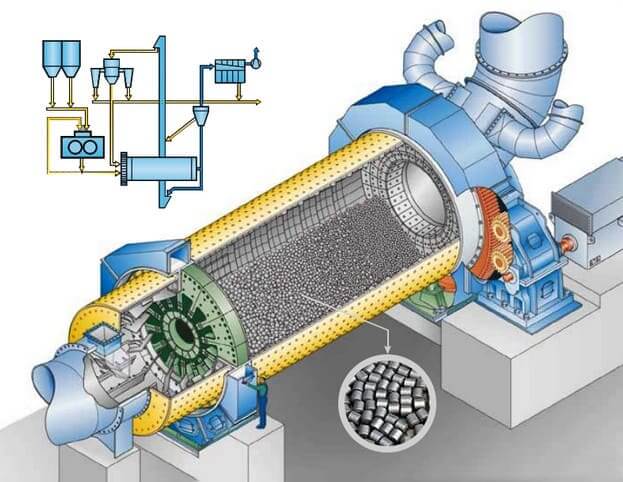
Main Structure Components
- Cylinder Body: Made of high-quality steel plate with replaceable liners.
- Grinding Media: Long steel rods (typically 50-100mm shorter than cylinder length).
- Drive System: Comprising motor, reducer, pinion gear, and electrical controls.
- Feed & Discharge Ends: Designed for efficient material flow.
- Bearing System: Supports the rotating drum with smooth operation.
Grinding Methods
- Wet Grinding: Primary application method where water facilitates material flow and particle separation.
- Dry Grinding: Occasionally used for special materials requiring moisture-free processing.
Rod Mill Types
- Peripheral Discharge Type: Features discharge ports around the cylinder perimeter.
- End Peripheral Discharge Type: Combines end and peripheral discharge advantages.
- Center Peripheral Discharge Type: Offers controlled discharge through center openings.
Advantages
- Minimizes slime production
- More energy-efficient for certain materials
- Lower operating costs in specific applications
- Better control of product fineness
Principle
Place the ore into a rotating cylinder containing a certain number and length of steel rods. Through the rotation of the cylinder and the impact and friction of the steel rods, the ore is ground into the required fine particles. The ore is continuously struck and crushed by the steel rods inside the rod mill, gradually becoming finer until the desired particle size is achieved.
Specification
| Model | Cylinder Diameter (mm) | Cylinder Length (mm) | Motor Power (kW) | Motor Speed (r/min) | Capacity (t/h) | Effective Volume (m3) | Weight (kg) |
| MBY0918 | 900 | 1800 | 22 | 730 | 0.62~3.2 | 0.9 | 5700 |
| MBY0924 | 900 | 2400 | 30 | 730 | 0.81~4.3 | 1.2 | 5880 |
| MBY1224 | 1200 | 2400 | 45 | 730 | 0.4~4.9 | 2.28 | 12308 |
| MBY1530 | 1500 | 3000 | 95 | 725 | 0.4~4.9 | 5 | 19990 |
| MBYg1530 | 1500 | 3000 | 80 | 725 | 2.4~7.5 | 5 | 21210 |
| MBYg2130 | 2100 | 3000 | 180 | 735 | 14~35 | 9 | 42123.5 |
| MBYg2136 | 2100 | 3600 | 210 | 735 | 43~61 | 10.8 | 45800.5 |
| MBYg2430 | 2400 | 3000 | 280 | 735 | 43~61 | 11.5 | 55795 |
| MBYg2732 | 2700 | 3200 | 320 | 750 | 43~61 | 15.7 | 83110 |
| MBYg2736 | 2700 | 3600 | 380 | 743 | 32~86 | 17.7 | 90441 |
| MBY2740 | 2700 | 4000 | 400 | 187.5 | 43~110 | 20.4 | 75000 |
| MBY3040 | 3000 | 4000 | 570 | 740 | 54~135 | 26 | 90000 |
| MBY3245 | 3200 | 4500 | 800 | 167 | 64~180 | 31 | 113000 |
| MBY3645 | 3600 | 4500 | 1250 | 150 | 80~230 | 41.8 | 139000 |
| MBY3654 | 3600 | 5400 | 1600 | 150 | 100~250 | 49.7 | 150000 |