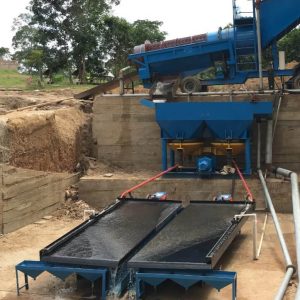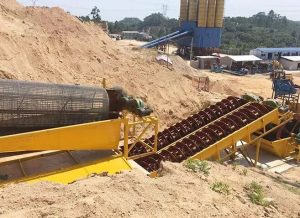
Chalcocite is an important copper mineral resource, but with a grade of only 0.8%, direct smelting is too costly. Efficiently processing low-grade chalcocite has become a major challenge for many mines.
The most cost-effective method to treat chalcocite with a 0.8% grade is flotation. After crushing and grinding, specific reagents are added to separate chalcocite from gangue minerals, increasing the grade to 20-30%. The key lies in reagent selection and process optimization to maximize recovery while controlling costs.
Processing low-grade chalcocite requires comprehensive consideration of ore characteristics, process flows, and economic feasibility. Let’s analyze each step in detail to help you find the optimal solution.
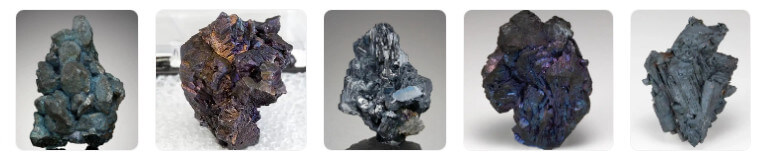
What Is the Difference Between Chalcocite and Chalcopyrite?
Both chalcocite and chalcopyrite are common copper minerals, but they differ significantly in properties and beneficiation methods. Understanding these differences is crucial for choosing the right treatment approach.
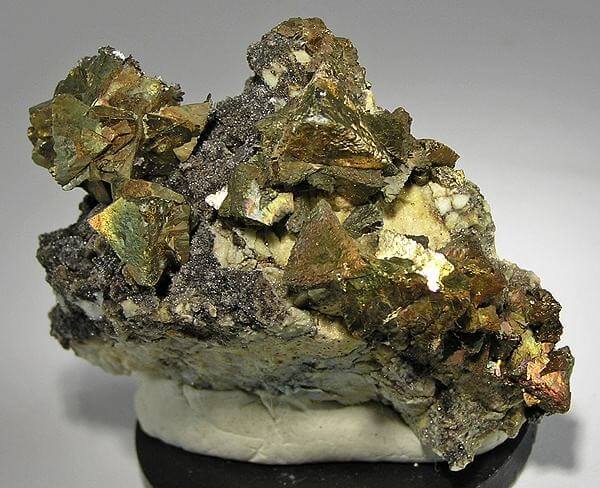
The main differences between chalcocite (Cu₂S) and chalcopyrite (CuFeS₂) lie in their chemical composition and floatability. Chalcocite contains up to 79.8% copper and is easily floatable, while chalcopyrite has only 34.5% copper and often requires activators. Chalcocite’s lower hardness (2.5-3) makes it prone to overgrinding, whereas chalcopyrite (3.5-4) requires finer grinding.
Let’s examine the differences in more depth:
Chemical & Physical Properties
| Property | Chalcocite | Chalcopyrite |
| Formula | Cu₂S | CuFeS₂ |
| Theoretical Cu% | 79.8% | 34.5% |
| Hardness | 2.5-3 | 3.5-4 |
| Density | 5.5-5.8 g/cm³ | 4.1-4.3 g/cm³ |
| Floatability | Excellent, but brittle and prone to overgrinding | Good, with mature processing technology |
| Chemical leaching | High (continuous dissolution of copper ions) | Low |
| Associated silver | Common, with a recovery rate of 70%–80% | Low |
Flotation Behavior
Chalcocite has excellent natural floatability and responds well to xanthate collectors. Chalcopyrite requires activation, typically using copper sulfate. The optimal pH range for chalcocite is broader (6-11), while chalcopyrite works best at pH 9-11.5.
What Is the Complete Beneficiation Process for Chalcocite?
Processing low-grade chalcocite ore efficiently requires overcoming significant technical challenges – from excessive energy costs in grinding to low recovery rates. Many operations struggle to achieve profitable results with 0.8% grade material due to these hurdles.
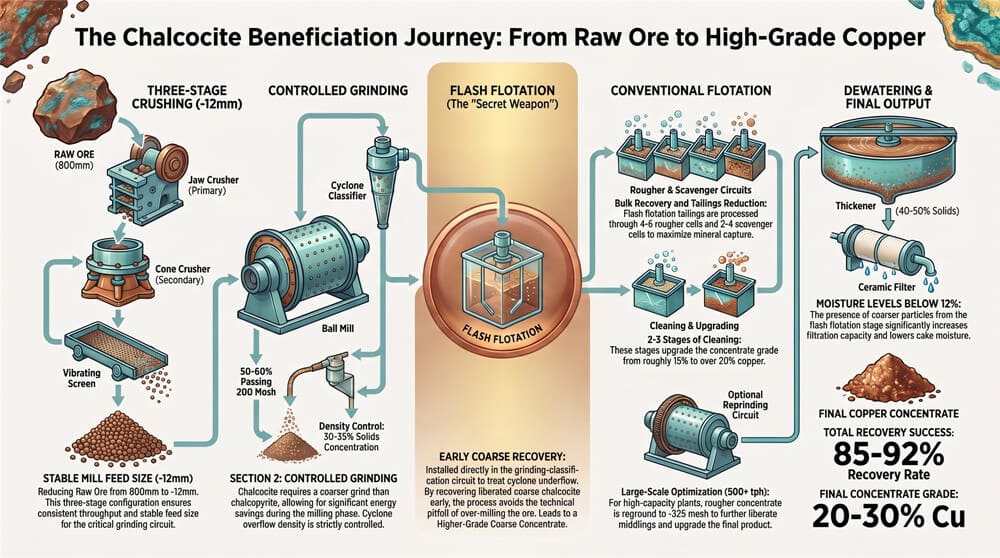
The complete chalcocite beneficiation process comprises: three-stage crushing (to -12mm), controlled grinding (50-60% -200 mesh), flash flotation for early coarse recovery, conventional rougher-scavenger-cleaner circuits, optional regrinding, and high-efficiency dewatering. This flowsheet maximizes recovery (85-92%) while producing 20-30% Cu concentrate. Key innovations like flash flotation and staged grinding address chalcocite’s tendency to overgrind.
Let’s break down the critical stages:
Step 1: Crushing – Three-Stage Closed-Circuit to -12mm
The raw ore (500- 800 mm lump size) is too large for direct milling. Standard configuration includes:
- Primary: Jaw crusher (coarse crushing)
- Secondary: Cone crusher (medium/fine crushing)
- Screening: Vibrating screen (closed-circuit)
➤ Oversized material returns to the cone crusher
➤ -12mm product feeds to the grinding circuit
Key benefit: Ensures stable mill feed size and consistent throughput
Step 2: Grinding – The Most Critical Stage
Ball mill + cyclone classifier configuration:
- Target grind size: 50-60% passing 200 mesh
- Coarser than chalcopyrite requirements
- Cyclone overflow density controlled at 30-35% solids
Step 3: Flash Flotation – Chalcocite’s “Secret Weapon”
Installed in the grinding-classification circuit
- Treats cyclone underflow
- Recovers liberated coarse chalcocite before overgrinding
Results
- 15-25% Cu recovery upfront
- Higher-grade coarse concentrate
- Easier dewatering
Step 4: Conventional Flotation – Rougher+Scavenger+Cleaner
Flash flotation tailings feed the main circuit
- Rougher: 4-6 cells (bulk recovery)
- Scavenger: 2-4 cells (tailings reduction)
- Cleaner: 2-3 stages (grade upgrading)
For 500+ tph plants
- Rougher concentrate regrinding
- Ball mill (φ1.2×2.4m, $30-50k investment) to -325 mesh
- Additional 2-3 cleaning stages purpose: Liberate middlings; Upgrade from 15% to 20%+ Cu.
Step 5: Concentrate Dewatering
Two-stage water removal
- High-rate thickener: 40-50% solids underflow
- Ceramic filter: Final moisture <12%
Advantage
- Coarser chalcocite particles (from flash flotation)
- Higher filtration capacity
- Lower cake moisture
Complete Process Flow:
Jaw Crusher → Cone Crusher → Vibrating Screen → Ball Mill → Cyclone → [Flash Flotation] → Rougher → Scavenger → Cleaner → [Regrind Mill] → Thickener → Ceramic Filter → Final Copper Concentrate
What Recovery and Concentrate Grade Can Be Achieved?
In practice, chalcocite beneficiation performance depends on multiple factors. Proper design and operation can produce excellent results.
Standard chalcocite plants achieve 85-92% copper recovery with a 20-30% concentrate grade. Under optimal conditions, high-purity chalcocite may reach over 40%. Key factors include ore characteristics, grind size, and reagent regime.
Performance variations under different conditions:
Recovery vs. Feed Grade
| Feed Grade | Typical Recovery | Concentrate Grade |
| >1.2% | 88-92% | 25-35% |
| 0.8-1.2% | 85-88% | 20-25% |
| <0.8% | 80-85% | 18-22% |
Performance Improvement Measures
- Pre-concentration: XRT sorting for waste rejection
- Stage grinding: Minimize overgrinding of chalcocite
- Advanced reagents: Combined TY-3 collector and 730A frother
What Equipment and Investment Are Needed for a 500 t/h Chalcocite Plant?
Developing a mid-sized chalcocite processing plant requires careful equipment selection and budget planning. Economies of scale apply significantly here.
Key equipment for 500 t/h capacity includes: jaw crusher, cone crushers, vibrating screen, ball mills, XCF/KYF flotation cells, thickener, flash flotation machine, conveyor belts, etc. Total investment is $12–20 million, with equipment accounting for 50-60%.
Detailed cost breakdown:
| Stages | Core Equipment | Investment(Ten Thousand $) |
| Crushing | Jaw Crusher + Cone Crusher + Vibrating Screen | 18-30 |
| Grinding | Ball mill (φ2.4 × 4.5m) + cyclone | 12-18 |
| Flash Flotation | Flash flotation machine * 1pcs | 4-8 |
| Conventional Flotation | Roughing (4 cells) + scavenging (4 cells) + cleaning (3 cells) | 22-35 |
| Regrinding(Optional) | Regrinding ball mill (φ1.2 × 2.4m) | 4-8 |
| Dewatering | Thickener + ceramic filter | 7-12 |
| Auxiliary Equipment | Feeder, conveyor belt, pumps, reagent dosing system | 12-18 |
| Total Equipment Cost | 80-128 | |
| Civil Works + Installation + Design | 27-45 | |
| Total Investment | 112-173 |
Note: Compared to standard copper concentrators, a chalcocite processing plant entails higher costs due to two specific pieces of equipment: the flash flotation machine and the regrinding mill. However, these units can boost recovery rates from 80% to over 90%, and the value of the additional copper recovered in a single year far exceeds the investment cost of the equipment.
Conclusion
Processing low-grade chalcocite ore (0.8% Cu) efficiently requires a tailored beneficiation approach, with flotation being the most cost-effective method to upgrade concentrate grades to 20-30% while achieving 85-92% recovery. Key distinctions between chalcocite and chalcopyrite—such as composition, floatability, and grinding requirements—highlight the need for optimized reagent regimes and staged grinding to prevent overgrinding losses. A complete flowsheet includes three-stage crushing, controlled grinding, flash flotation for early recovery, and conventional flotation circuits, complemented by regrinding and dewatering. For a 500 t/h plant, equipment investments range from $12–20 million, with flash flotation and regrinding mills proving critical for maximizing returns. By addressing chalcocite’s unique challenges through advanced techniques, operators can transform low-grade ore into profitable copper concentrate.