If you have a copper oxide ore deposit and are planning to build a copper processing plant, the first questions are usually:
- What is the oxidation rate of the ore?
- Which processing method is suitable?
- What equipment is required?
What metallurgical tests should be conducted before plant design?
No single copper oxide processing flowsheet suits every deposit. Ore mineralogy, oxidation rate, copper grade, sulfide/oxide distribution, gangue composition, clay content, acid consumption, flotation response, leaching kinetics, and required recovery all influence the final process design.
As a preliminary screening framework, copper oxide ores can be broadly divided into three processing scenarios:
- Low oxidation rate: investigate sulfidization and flotation
- Moderate oxidation rate: investigate flotation combined with leaching
- High oxidation rate or high clay content: investigate hydrometallurgical routes such as heap leaching or agitated leaching, followed by copper recovery
However, oxidation rate should be used only as a screening parameter. The final flowsheet should be determined through representative sampling, mineralogical analysis, metallurgical testing, process design, and economic evaluation.
The basic principle is:
Start with the ore characteristics → determine the appropriate recovery method → conduct metallurgical testing → establish the flowsheet → select and size the equipment.
How to Choose a Copper Oxide Ore Processing Method?
The most appropriate processing method depends primarily on how copper occurs in the ore and how the copper minerals respond to different recovery methods.
A simplified decision framework is:
Low oxidation rate → Sulfidization + Flotation
Moderate oxidation rate → Flotation + Leaching
High oxidation rate → Heap Leaching or Agitated Leaching + Copper Recovery
This framework is useful for preliminary process screening, but it should not be used as the sole basis for plant design.
Two copper oxide ores with similar oxidation rates can have very different processing characteristics because their copper minerals, gangue minerals, clay content, and acid consumption may be different.
Therefore, the key question is not simply:
“How oxidized is the ore?”
It is:
“What copper minerals are present, and how can the copper be recovered efficiently?”
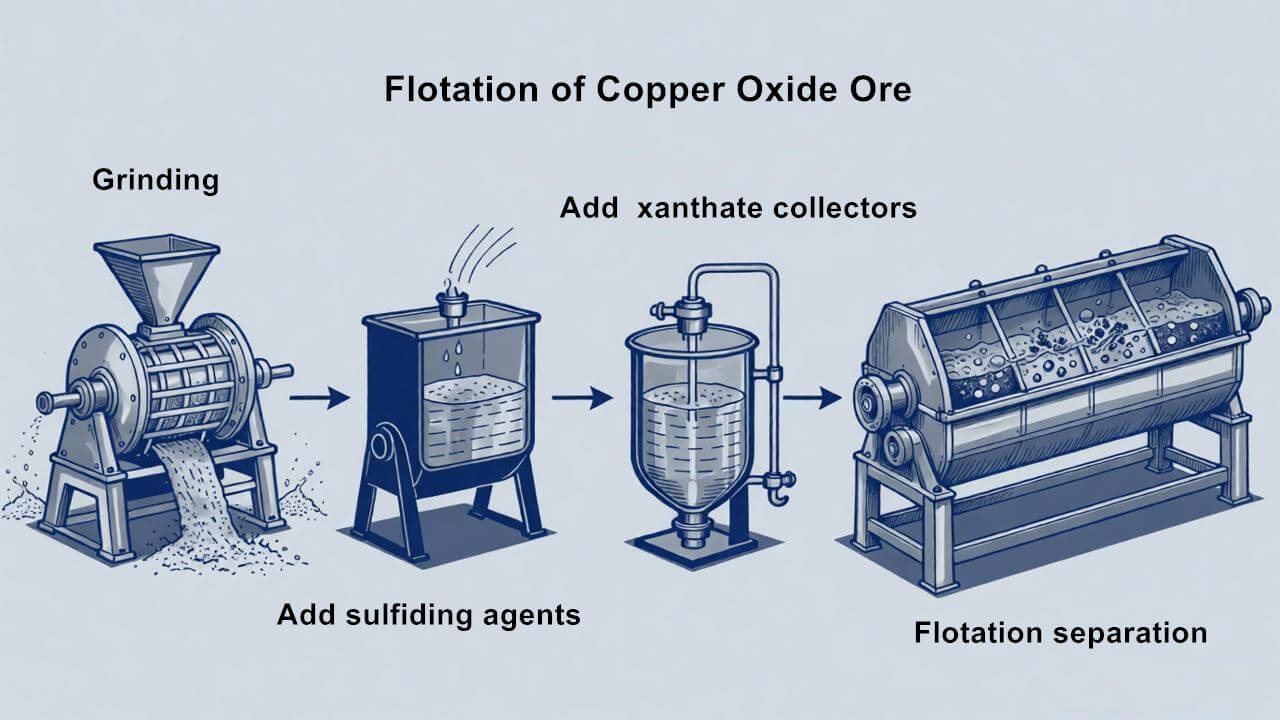
1. Low Oxidation Rate Copper Ore: Sulfidization and Flotation
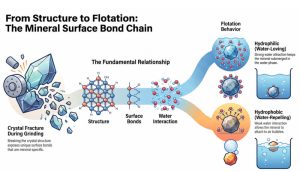
When the ore contains a relatively high proportion of flotation-responsive copper minerals, flotation may be the first processing route to investigate.
For suitable oxide copper minerals, sulfidization can be used to modify the mineral surface and improve its response to sulfide flotation reagents.
A typical flowsheet is:
Crushing → Grinding → Sulfidization → Conditioning → Flotation → Concentrate Dewatering
The objective is to liberate copper-bearing minerals from the gangue and recover them into a copper concentrate.
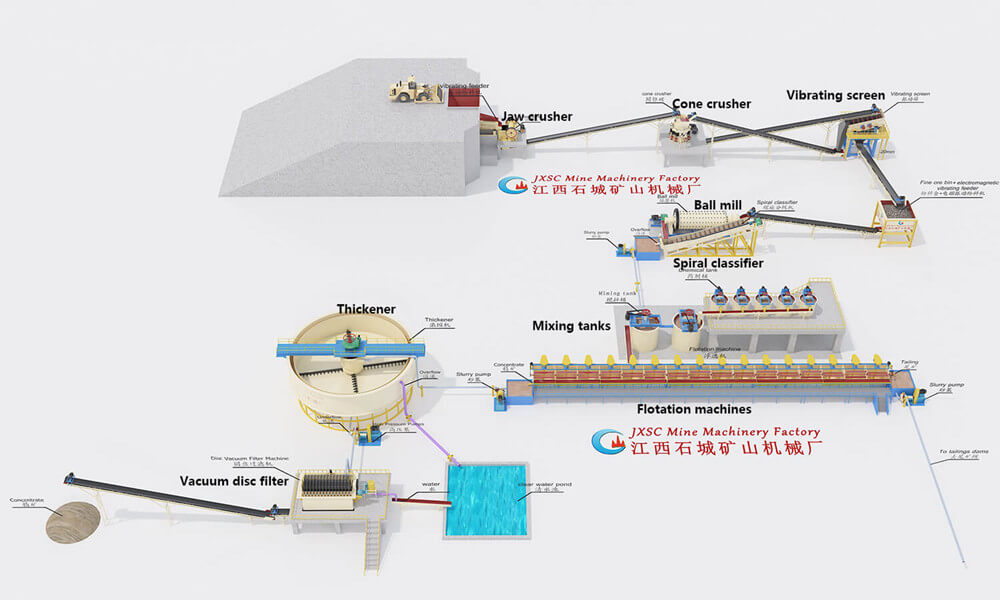
Crushing Section
The crushing circuit normally includes: Jaw crusher, cone crusher, vibrating feeder, vibrating screen, belt conveyors, ore bins or hoppers.
The purpose of crushing is to reduce run-of-mine ore to a suitable particle size for subsequent grinding.
The crushing configuration should be determined according to the ore characteristics, feed size, required grinding size, and plant capacity.
Grinding and Classification Section
Typical equipment includes: Ball mill, hydrocyclone or classifier, slurry pumps, agitation tank.
Grinding liberates copper-bearing minerals from gangue minerals.
The required grinding fineness should not be selected only according to plant capacity. It should be established through grinding and flotation tests because excessive grinding can increase energy consumption and may negatively affect downstream flotation.
Flotation Section
The flotation circuit may include: Conditioning tanks, rougher flotation cells, scavenger flotation cells, cleaner flotation cells, and reagent dosing equipment.
The flotation circuit is normally configured with roughing, scavenging, and cleaning stages. The exact configuration depends on copper mineralogy and the required concentrate grade and recovery.
Concentrate Dewatering Section
The concentrate handling system may include: Thickener, Filter press, concentrate handling equipment.
The final product is normally a dewatered copper concentrate suitable for transportation and downstream smelting or other treatment.
However, a low oxidation rate does not automatically guarantee good flotation performance. Mineralogical testing is still necessary to determine whether the copper minerals can be effectively recovered by sulfidization and flotation.
2. Moderate Oxidation Rate: Flotation + Leaching
When an ore contains both recoverable sulfide copper minerals and significant oxide copper minerals, a combined processing route may be considered.
Recommended route
Sulfide Flotation → Oxide Copper Leaching → Copper Recovery
The basic concept is to recover the flotation-responsive copper minerals first and then treat the remaining copper-bearing material by leaching.
Depending on the ore characteristics, the leach solution may subsequently undergo precipitation or another copper recovery step.
Why Use a Combined Process?
A single flotation circuit may leave a considerable amount of oxide copper in the tailings.
Conversely, sending the entire ore stream directly to leaching may not be the most appropriate option when a significant portion of the copper occurs as minerals that can be effectively recovered by flotation.
A combined flowsheet attempts to recover copper from both mineral fractions.
Typical Equipment
The plant may contain the complete flotation equipment described above, plus a hydrometallurgical section.
- Flotation: Jaw crusher, cone crusher, vibrating screen, ball mill, hydrocyclone, conditioning tanks, flotation machines, reagent dosing system, thickener, filter press.
- Leaching: Agitated leaching tanks, Slurry pumps, Reagent preparation and dosing equipment, Neutralization tanks, Solid-liquid separation equipment.
- Copper recovery: Depending on the selected flowsheet, the plant may use precipitation equipment, filter equipment, solution storage tanks, pumps, and pipelines.
The exact recovery method should be selected according to copper concentration in the pregnant solution, impurity levels, reagent consumption, and the required final product.
The combined flotation-leaching route is more suitable for projects where metallurgical testing demonstrates a meaningful benefit from treating both sulfide and oxide copper minerals.
3. High Oxidation Rate or High-Clay Copper Ore: Hydrometallurgical Processing
When copper occurs predominantly as oxide minerals and flotation performance is poor, hydrometallurgical processing may be investigated.
Two important approaches are:
- Heap leaching
- Agitated leaching
A typical hydrometallurgical route is:
Crushing → Leaching → Solution Collection → Copper Recovery
For an SX-EW operation, this may become:
Crushing → Heap Leaching → Pregnant Leach Solution → Solvent Extraction → Electrowinning → Copper Cathode
The appropriate leaching method depends strongly on ore permeability, clay content, copper mineralogy, acid consumption, leaching kinetics, and particle size requirements.
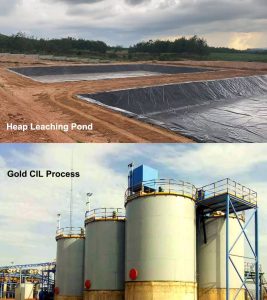
(1) Heap Leaching for Copper Oxide Ore
Heap leaching can be considered when the ore has favorable leaching characteristics and sufficient permeability.
A simplified flowsheet is:
Crushing → Screening → Heap Construction → Acid Irrigation → Pregnant Leach Solution Collection → Solvent Extraction → Electrowinning
Crushing and Screening
The crushing section may include: Primary crusher, Secondary crusher, Vibrating screen, Belt conveyors, Stockpile or ore bin.
Compared with a conventional flotation plant, a heap-leach operation may not require a ball mill because fine grinding is generally not the primary objective.
The required crushing size should be established through metallurgical testing and permeability evaluation.
Heap-Leach System
The heap-leach system may include: Heap-leach pad, Impermeable liner system, Ore stacking system, Irrigation system, Pregnant solution collection system, Solution ponds, Pumps, Raffinate storage and circulation system.
The heap-leach pad and solution-management system are critical components of the operation.
Clay content and fines generation must be carefully evaluated because poor permeability can restrict solution flow through the heap and reduce leaching performance.
Solvent Extraction
When SX-EW is selected, the solvent-extraction section may include: Extraction stages, Stripping stages, Mixer-settlers, Organic circulation system, Pumps, Storage tanks, Electrolyte circulation system.
Solvent extraction transfers copper from the leach solution into an electrolyte suitable for electrowinning.
Electrowinning
The electrowinning section may include: Electrowinning cells, Rectifier, Transformer, Busbars, Electrodes, Electrolyte circulation system, Acid-resistant pumps and pipelines, Cathode handling equipment.
The process produces copper cathodes directly from the copper-bearing electrolyte.
(2) Agitated Leaching for Difficult or Fine-Grained Copper Ore
If the ore has poor heap permeability, significant fines or clay, or requires more intensive contact between the ore and leaching solution, agitated leaching may be investigated.
A simplified process is:
Crushing → Grinding or Ore Preparation → Agitated Leaching → Solid-Liquid Separation → Copper Recovery
Typical Equipment
The process may include: Crushing equipment, grinding equipment, where required, Agitated leaching tanks, Agitators, Reagent preparation system, Reagent dosing system, Slurry pumps, Thickeners, Filters, Solution tanks, Solvent extraction equipment, Electrowinning cells, Rectifier and transformer, Acid-resistant pipelines and pumps.
When Should Agitated Leaching Be Considered?
Agitated leaching may be investigated when:
- Heap permeability is poor
- The ore contains significant fines or clay
- Faster leaching kinetics are required
- Fine particle preparation improves copper dissolution
- Laboratory tests demonstrate a significant recovery advantage
However, agitated leaching generally involves more equipment and more complex solid-liquid separation than a simple heap-leach system.
Therefore, the process should be justified by metallurgical test results.
Key Parameters for Copper Oxide Processing
Oxidation rate is important, but it should not be the only parameter used for process selection.
The following parameters should normally be investigated.
| Parameter | Why It Matters |
| Copper grade | Determines the amount of copper available for recovery |
| Oxidation rate | Provides an initial indication of flotation and leaching potential |
| Copper mineralogy | Identifies the actual copper-bearing minerals |
| Sulfide/oxide distribution | Helps determine whether a combined process is appropriate |
| Clay content | Influences crushing, grinding, flotation, and heap permeability |
| Acid consumption | Critical for evaluating leaching performance |
| Bond work index | Helps determine grinding requirements |
| Flotation response | Indicates whether flotation can effectively recover copper |
| Leach kinetics | Determines the rate and extent of copper dissolution |
| Impurity levels | Affect concentrate quality and hydrometallurgical processing |
| Recovery | Determines the amount of copper ultimately recovered |
| Tailings characteristics | Affect downstream tailings and environmental design |
The more accurately these parameters are determined, the more reliable the final flowsheet and equipment selection will be.
Conclusion
Selecting the optimal processing method for copper oxide ores requires comprehensive mineralogical analysis and metallurgical testing that goes beyond simply evaluating oxidation rates. Each deposit is unique, with varying mineral assemblages, gangue compositions and metallurgical responses that influence the economic viability of different processing routes. By systematically analyzing ore characteristics, conducting representative tests, and evaluating both technical and economic factors, operators can develop a tailored flowsheet that maximizes copper recovery while minimizing operating costs. The ultimate success of any copper oxide processing plant lies in matching the right combination of crushing, grinding, flotation and/or leaching technologies to the specific mineralogy and metallurgical behavior of the ore being processed. Careful testwork and process design at the feasibility stage help ensure the selected circuit delivers optimal performance throughout the mine’s operating life.