Choosing the right method to extract gold can make or break your operation. High costs, low recovery – these pains haunt mine operators daily. But what if you could confidently select the optimal process every time?
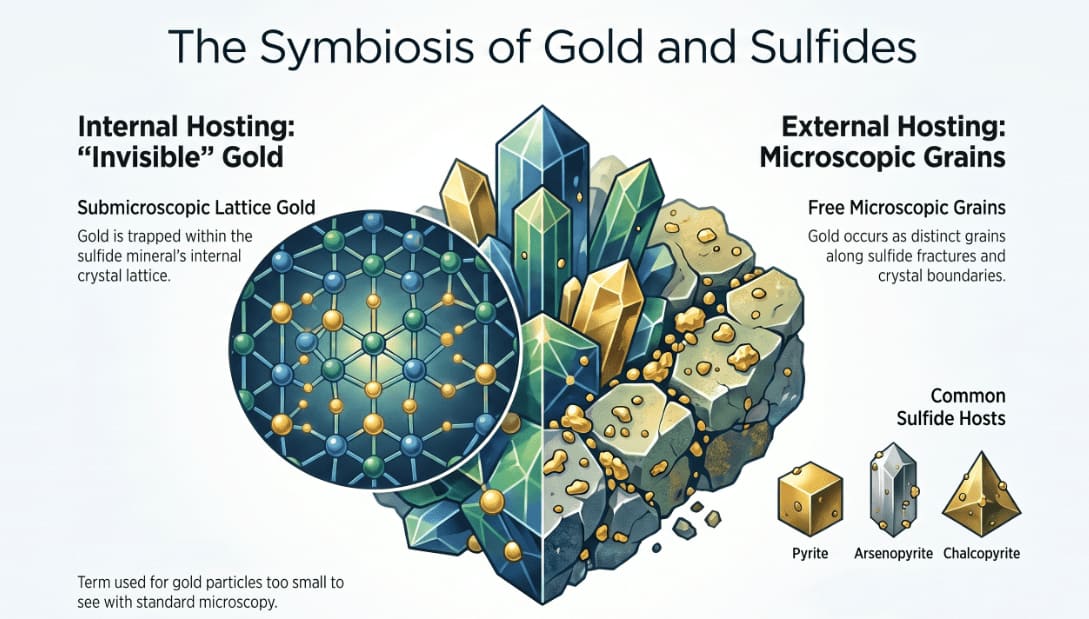
The choice between flotation and leaching depends on gold’s association with sulfides. If gold is locked within sulfide minerals (such as pyrite), flotation works best. If gold occurs free in the ore, leaching yields better recovery. The key isn’t just “sulfide presence” but how tightly gold binds to those sulfides.
Now that we understand the core principle, let’s break down the details. We’ll examine each method, then show you how to make the perfect choice for your ore.
Gold Flotation: When Does It Work Best?
Seeing gold recoveries below 70%? Wasting reagents on unresponsive ore? Flotation solves these problems – but only for specific gold types.
Floating is suitable for ores that contain gold in close association with sulfides such as pyrite, arsenopyrite, and magnetite. Flotation excels when gold particles are too fine for gravity separation and are physically enclosed in sulfide minerals. It captures gold-bearing sulfides in a concentrate, reducing subsequent processing volumes. Key indicators for flotation: gold occurs as tiny inclusions in pyrite/arsenopyrite, or the ore contains significant sulfide content (above 15-20%).
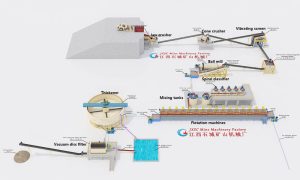
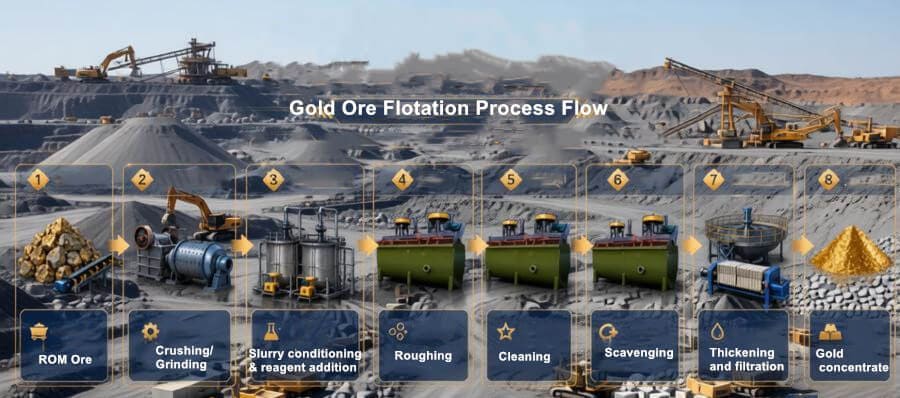
The typical process flow is as follows:
Grinding and classification → Slurry adjustment and chemical addition → Roughing → Concentration → Sweep → Gold concentrate or gold-bearing sulfide concentrate.
The advantage of flotation is that it allows for the initial enrichment of gold-bearing minerals, thereby reducing the volume of material requiring subsequent processing. However, if the gold does not float with the sulfides, the effectiveness of flotation will be limited.
Three Critical Factors for Successful Gold Flotation
1. Liberation Size
- Target: Gold should be fully liberated at grind sizes below 75μm
- Problem: Coarse gold causes losses in tailings
- Solution: Conduct grind optimization tests
2. Sulfide-Gold Association
- Strong association: Best case (e.g., gold locked in pyrite crystals)
- Surface attachment: Moderate (may need collector optimization)
- No association: Poor candidate for flotation
3. Ore Mineralogy
| Mineral | Good for Flotation? | Notes |
| Pyrite | Yes | Primary carrier |
| Arsenopyrite | Yes | Needs pH control |
| Quartz | No | Needs leaching |
| Tellurides | Maybe | Special collectors needed |
Flotation becomes essential when:
- Ore contains gold + base metals (Cu/Pb/Zn)
- You need to reduce cyanide consumption
- The plant already has flotation infrastructure
Gold Leaching: Where Does It Outperform?
Frustrated by low gold recoveries from sulfide ores? Spending too much on grinding? Leaching might be your answer – if your gold meets these conditions.
Cyanide or alternative leaching works best when gold exists as free particles or surface coatings on non-sulfide minerals. Ideal scenarios include oxidized ores, coarse gold (with gravity preconcentration), or ores where grinding fully exposes gold particles. Carbon-in-pulp (CIP) remains the gold standard for leaching plants.
Leaching Decision Tree
Gold Liberation Assessment
- Conduct diagnostic leach tests
- Measure recovery at different grind sizes
- Target >90% gold exposure at P80 of 75μm
Interfering Elements
Problem elements:
- Copper: Consumes cyanide
- Arsenic: Requires special handling
- Carbonates: Cause pH issues
Process Selection Guide
| Ore Type | Best Leach Method | Expected Recovery |
| Free milling | Straight CIP | 92-96% |
| Refractory | Pre-oxidation + CIP | 80-90% |
| Carbonaceous | CIL with preg-robbing control | 85-93% |
| High silver | Intensive leaching | 90-95% |
Critical leaching advantages:
- Handles coarse gold better than flotation
- Lower capital cost for simple ores
- Easier to scale for small deposits
Combined Routes: How to Optimize Gold Recovery?
Common Combined Process Routes
1. Gravity Concentration + Leaching
- Best for: Coarse free gold (>50μm)
- Typical recovery: 20-50% by gravity, balance by leaching
- Equipment sequence: → Knelson concentrator → Intensive leaching of gravity concentrate → Standard CIP for tails
2. Flotation + Concentrate Treatment
Used when: Sulfides carry significant gold Options:- Direct cyanidation of flotation concentrate
- Pressure oxidation → leach
- Roasting → leach
3. Pre-Oxidation + Leaching
For refractory ores where gold is locked in:- Sulfides (bio-oxidation)
- Tellurides (pressure oxidation)
- Carbonaceous matter (chlorination)
| Ore Characteristic | Recommended Combined Route | Expected Recovery Gain |
| Coarse free gold + fine sulfides | Gravity + flotation + leach | +8-15% |
| Partially refractory sulfides | Flotation + concentrate oxidation | +10-20% |
| High silver content | Gravity + intensive leach | +5-12% |
- Always recover coarse gold first
- Match oxidation level to mineralogy
- Consider bulk vs. selective flotation
- Test intermediate products for optimal cut-off grades
Methods for Determining Whether to Use Flotation or Leaching for Gold Ore
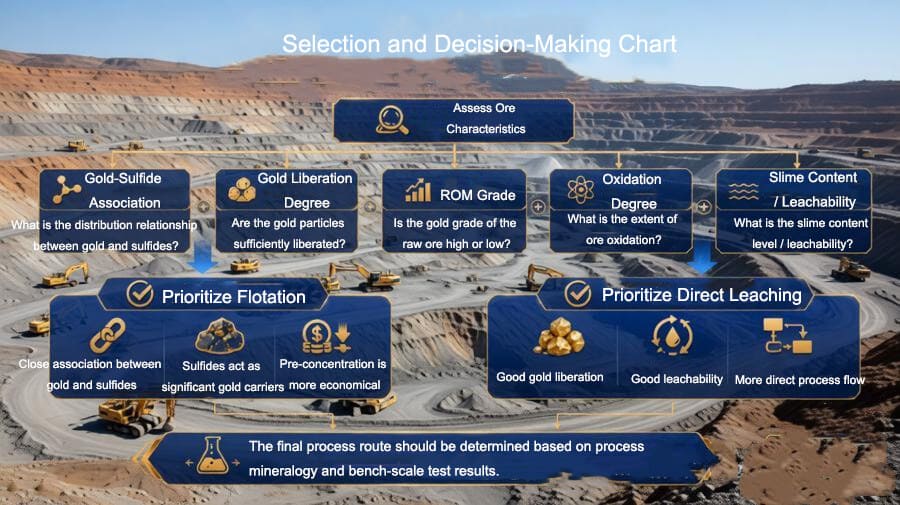
The Six-Step Decision Protocol
1. Process Mineralogy (Week 1) Must-do tests:- QEMSCAN for mineral associations
- Electron microprobe for gold deportment
- MLA for liberation characteristics
- Particle size distribution (coarse >50μm vs fine <10μm)
- Shape factor (rounded vs angular)
- Surface purity (clean vs coated)
| Association Type | Flotation Suitability | Leach Suitability |
| Locked in sulfides | ★★★★★ | ★ |
| Attached to sulfides | ★★★☆ | ★★☆ |
| Free in matrix | ☆ | ★★★★★ |
- Test P80 from 150μm to 38μm increments
- Plot recovery vs energy consumption
- Target: 95% gold exposure at economic grind size
- Standard sulfhydryl collectors (Xanthates)
- pH 8-9.5 range
- 3-stage cleaning
- 24-48 hour retention
- 5-1.0g/L NaCN
- Carbon-in-pulp
- Capex per ton of ore
- Operating cost per oz produced
- NPV difference between options
- Tailings toxicity
- Cyanide destruction requirements
- 58μm average gold size
- 70% gold in pyrite
- Best recovery at P80 75μm
- Pure leach gave only 68% recovery
- Pure flotation had 22% mass pull
- Combined achieved 89% recovery at $18/t cost
Conclusion
Gold extraction requires matching the method to your ore’s specific characteristics. Flotation suits sulfide-bound gold, while leaching fits free-milling ores. Combined processes often deliver the best economics for complex deposits. Proper testwork – going beyond simple sulfide content checks to examine actual gold-mineral associations – prevents costly processing mistakes. Always confirm lab results with pilot trials before finalizing your flowsheet.