Beryllium, a lightweight yet extraordinarily strong metal, plays a pivotal role in high-tech industries ranging from aerospace to nuclear energy. However, its scarcity and complex mineralogy pose significant challenges for extraction and purification. This article explores the global distribution of beryllium resources, key processing techniques, and innovative beneficiation methods that enhance recovery efficiency. From acid-flotation breakthroughs to alkaline pretreatment optimizations, we analyze the critical steps in transforming raw ores into high-purity beryllium—a process vital for sustaining supply chains in defense, electronics, and emerging technologies.
Global Distribution of Beryllium Resources
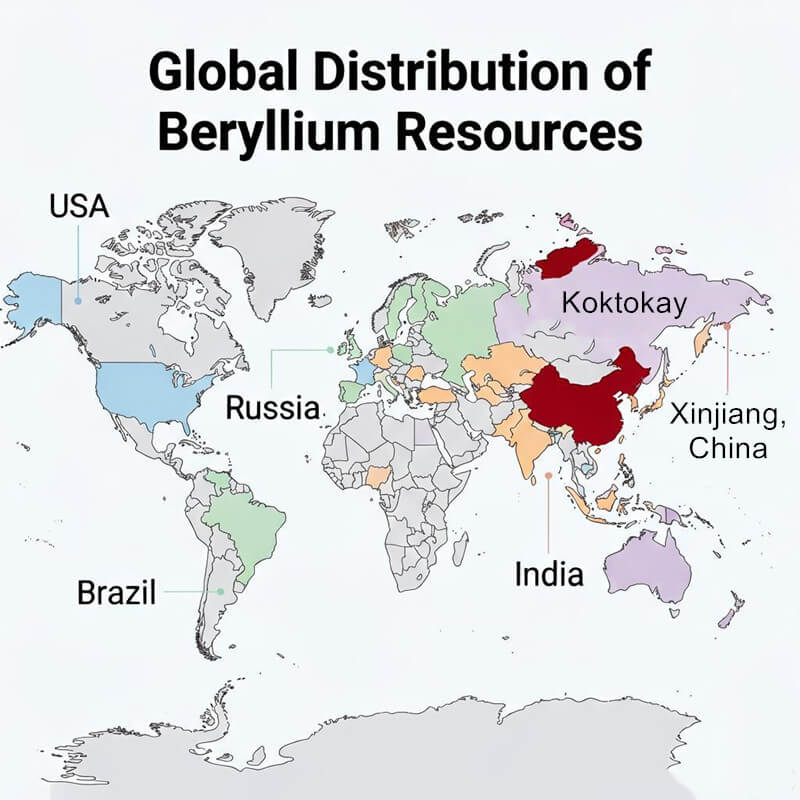
Beryllium is a strategically critical but geologically scarce metal, with over 95% of global reserves concentrated in just a few key countries. The following is an analysis of the global and Chinese beryllium resource distribution, highlighting production potential, geological characteristics, and supply-demand dynamics.
1. Global Beryllium Resource Distribution
(1) United States – The Dominant Supplier (60% of Global Reserves)
Primary Reserves:
- Estimated at ~280,000 tonnes of beryllium content(USGS 2024).
- Utah’s Spor Mountain(>70% of U.S. reserves) hosts the world’s richest bertrandite (hydroxysilicate) deposit, averaging 5–1.0% BeO.
- Alaska also contains unexploited pegmatite-hosted beryl
Production & Control:
- Materion Corporation operates the only major refinery (in Elmore, Ohio), supplying 80% of the global high-purity beryllium metal market.
- Uses solvent extraction for bertrandite processing (cost-effective compared to beryl).
(2) Brazil & Russia – Major Pegmatite-Based Resources
| Country | Reserves (Be Content) | Key Deposits | Mineral Type | Extraction Challenges |
| Brazil | ~45,000 t | Minas Gerais pegmatite belt | Beryl (gem-quality) | Manual sorting required (low mechanization) |
| Russia | ~26,000 t | Zashikhinsk (Siberia) | Phenakite/Helvite | High Th/U radioactivity |
Brazil: Traditionally the largest beryl producer (historically used in gemstones).
Russia: Focus on complex rare-metal pegmatites (potential for by-product recovery).
(3) Other Significant Producers
China (~15,000 t Be) → Mainly low-grade (≤0.1% BeO) pegmatites, requiring costly processing.
India & Argentina → Minor beryl reserves in granitic pegmatites.
Canada & Madagascar → Emerging exploration targets (unmapped potential).
2. China’s Beryllium Resources – Large but Challenging
Highly Concentrated but Low-Grade Deposits
- Sichuan (55% of China’s total)→ Jianchaling and Muli pegmatites (Li-Ta-Be polymetallic ores).
- Jiangxi (27%)→ Yichun granitic deposits (Nb-Ta-Be association).
- Xinjiang (15%)→ Koktokay No.3 pegmatite (historical source).
- Others→ Yunnan, Inner Mongolia (minor resources).
Processing Difficulties:
- Beryl (hard to concentrate): Requires flotation + acid leaching.
- Low-grade ores (≤0.1% BeO): High energy/chemical consumption.
3. Global Supply Chain & Strategic Implications
| Country | Reserves (Be, tonnes) | Production (Be, t/yr) | Key Strengths | Weaknesses |
| USA | 280,000 | ~250 | High-grade, advanced refining | Geopolitical control |
| Brazil | 45,000 | ~30 | Gem-quality beryl | Artisanal mining |
| China | 15,000 | ~20 | Integrated Li-Ta-Be recovery | Low economic viability |
Beryllium: Fundamental Properties and Applications
1. Basic Properties
Beryllium (Be) is a light gray metal with the following key characteristics:
Density: 1.85 g/cm³ (one of the lightest structural metals)
Melting point: 1,283°C | Boiling point: 2,970°C
Chemical behavior:
- Highly reactive but forms a protective oxide layer in air, enhancing corrosion resistance.
- Reacts with dilute acids and strong alkalis.
- Forms covalent compounds with high thermal stability (e.g., BeO ceramics).
Toxicity: All beryllium compounds are human carcinogens and require strict handling protocols.
2. Geochemical Distribution
Crustal abundance: Avg. 2.8 ppm, enriched in acidic igneous rocks (e.g., granites: ~5.5 ppm).
Principal ore minerals (60+ identified, major ones listed):
Mineral | BeO Content | Chemical Class | Economic Relevance |
Beryl | 9–14% | Cyclosilicate | Traditional primary source |
Bertrandite | 39–43% | Hydroxysilicate | Dominates modern production (USA) |
Phenakite | 43–46% | Nesosilicate | High-grade but rare |
Chrysoberyl | 19–21% | Oxide | Byproduct of gemstone mining |
3. Industrial Extraction Methods
Ore Processing:
- From Beryl: Requires high-energy sulfation or fluorination to break silicate bonds.
- From bertrandite: More cost-effective via acid leach-solvent extraction(preferred in the USA).
Metal Production:
- Electrolysis of BeF₂ or magnesium reduction of BeO yields 99.5% pure metal.
- Powder metallurgy is standard for fabricating parts (due to Be’s brittleness).
4. Critical Applications
Nuclear & Defense
- Neutron moderator/reflectorin reactors (low neutron absorption cross-section).
- Precision components in nuclear triggers (alloys with Pu/W).
Aerospace & Space
- Structural alloys(e.g., Be-Al for satellite frames, brake systems).
- Re-entry vehicle heatshields(BeO’s high thermal conductivity).
Electronics & Advanced Materials
- Beryllium-copper alloys(springs, connectors; ~75% of industrial use).
- X-ray windows(transparency to low-energy photons).
Emerging Technologies
- Fusion reactor first-wall materials(ITER project testing).
- Quantum computing substrates(ultrahigh-purity single crystals).
Supply Chain Challenges
- Geopolitical risks: The U.S. controls ~80% of refined Be production.
- Substitutes: Limited; composites (SiC/Al) fail to match Be’s neutron/thermal properties.
Mineral Processing of Beryllium Ore
Floatability of Beryllium Minerals
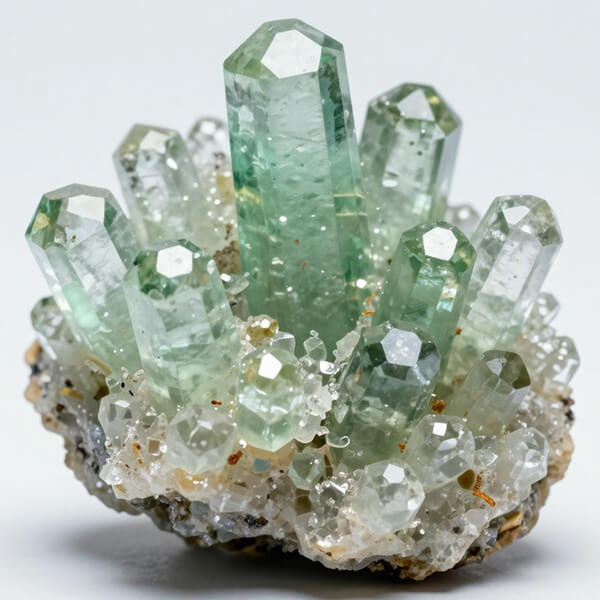
Beryl (3BeO·Al₂O₃·6SiO₂), containing 8%~12% BeO, has good floatability. It can be floated using oleic acid in weakly acidic, neutral, or alkaline media. Sulfonated petroleum can also be used in acidic media.
Beryl does not float without sulfuric acid. Its floatability increases with higher sulfuric acid dosage, peaking at 0.98 g/L, beyond which beryl is suppressed.
When using oleic acid as a collector, hydrofluoric acid (HF) activates beryl, with optimal activation at 200 g/t, but exceeding 500 g/t completely inhibits flotation.
Pretreatment with sodium hydroxide (NaOH) significantly enhances beryl recovery while minimally affecting feldspar recovery, aiding beryl-feldspar separation.
Sodium sulfide (Na₂S) inhibits quartz and feldspar while activating beryl. Using oleic acid after Na₂S pretreatment can yield a 5.9% BeO beryl concentrate.
Both anionic and cationic collectors can be used. With oleic acid, recovery is ~50%, but it increases to >80% with NaOH or HF pretreatment. Among cationic collectors, octadecylamine acetate is the most effective, with an optimal pH of 9–10.5.
Flotation Methods for Beryllium Ore
Without conditioning reagents, beryl cannot be separated from gangue using either anionic or cationic collectors. Thus, pre-treatment is essential, classified into:
- Acid method(sulfuric acid, hydrochloric acid, HF, etc.)
- Alkali method(NaOH, sodium carbonate, etc.)
Purpose of pre-treatment:
- Clean the mineral surface by removing heavy metal salts.
- Selectively dissolve surface silicates to expose beryllium ions.
- Enhance beryl floatability while suppressing gangue minerals.
The acid and alkaline flotation methods for beryl are briefly described below:
1. Acid Flotation of Beryl
Acid-based flotation methods are categorized into bulk flotation and differential flotation.
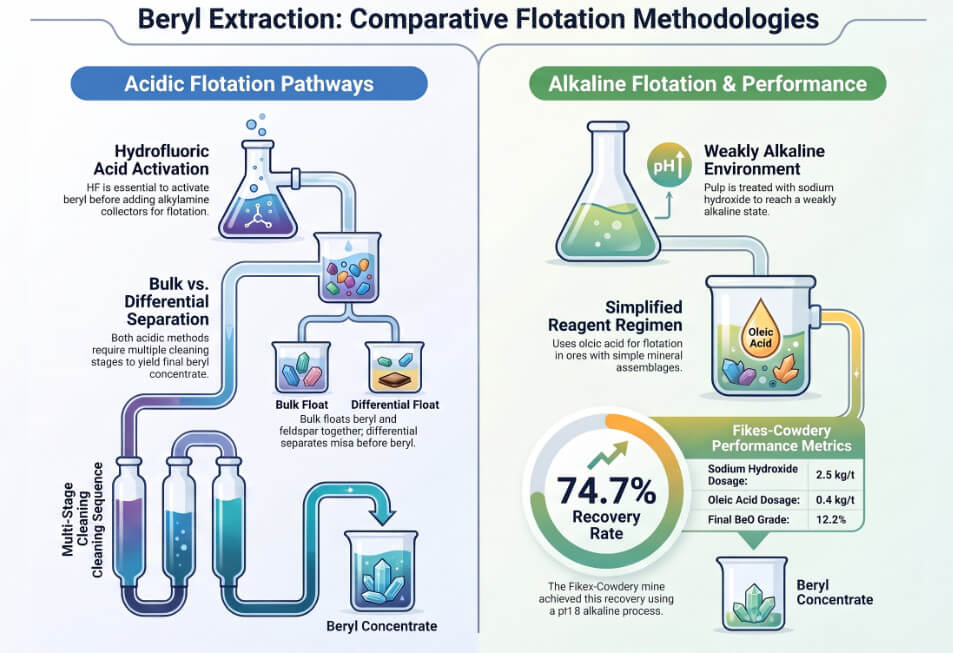
In bulk flotation, the pulp undergoes acid treatment to float both beryl and feldspar into the froth product, followed by a subsequent separation step. The specific procedure involves coarsely grinding the ore and floating sulfide minerals using xanthate. Next, mica is floated using an alkylamine salt in an acidic medium. After mica removal, hydrofluoric acid is added to activate the beryl, followed by the addition of an alkylamine salt to float both beryl and feldspar. The bulk rougher concentrate undergoes three cycles of dilution, thickening, and reagent removal; sodium carbonate is then added, and beryl is floated using an alkylamine salt. Finally, the beryl concentrate is obtained through multiple stages of cleaning.
Differential flotation involves floating mica first, followed by beryl. The specific procedure entails finely grinding the ore and floating mica using a cationic collector in a sulfuric acid medium. The resulting tailings are thickened and treated with hydrofluoric acid; beryl is then floated using an alkylamine salt, leaving tailings composed of feldspar and quartz. Hydrofluoric acid and a cationic collector are added to the beryl rougher concentrate, which then undergoes multiple cleaning stages to yield the final beryl concentrate.
2. Alkali Flotation of Beryl
The alkaline flotation process involves grinding the ore and desliming it, followed by treatment with sodium hydroxide or sodium carbonate and a subsequent washing step to render the pulp weakly alkaline. Oleic acid is then used to float the beryl; after several stages of cleaning, a beryl concentrate is obtained. This method is suitable for ores with relatively simple mineral assemblages.
The beryl flotation plant at the Fikes-Cowdery mine in the United States employs the alkaline flotation method. The run-of-mine ore contains minerals such as beryl, feldspar, mica, and quartz. After fine grinding and desliming, the ore is treated with sodium hydroxide (2.5 kg/t) and washed. Flotation is conducted at a pH of 8 using oleic acid (0.4 kg/t). Following two stages of cleaning on the rougher concentrate, a beryl concentrate containing 12.2% BeO is obtained, with a recovery rate of 74.7%.
The Path Forward for Beryllium Processing
As demand for beryllium grows alongside advancements in quantum computing and fusion energy, optimizing beneficiation methods becomes increasingly urgent. The dominance of U.S. bertrandite processing and China’s pursuit of pegmatite-based solutions highlight the geopolitical stakes of this critical metal. Future innovation must address low-grade ore challenges through hybrid flotation systems, reduced chemical consumption, and AI-driven mineral sorting. With 95% of reserves controlled by a handful of nations, sustainable and efficient extraction isn’t just an engineering challenge—it’s a strategic imperative for global energy and security infrastructure.