X-ray sorting machines can remove waste rock before it reaches the mill. In mineral processing, this early separation is called pre-concentration. It can raise the grade of the mill feed and reduce the amount of material that needs grinding. The result depends on how clearly the machine can distinguish ore from waste and how much valuable material it sends to the reject stream.
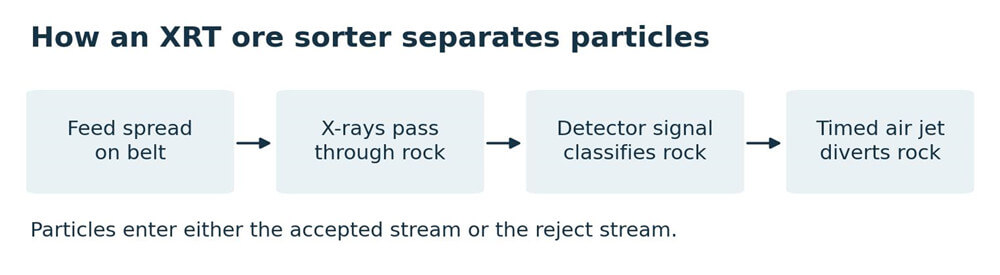
In X-ray transmission (XRT) sorting, a detector measures how much X-ray radiation passes through each rock on a conveyor. The signal depends on the rock’s composition, density and thickness. The machine classifies each particle from that signal, then typically uses timed air jets to direct selected particles into a separate stream. For a step-by-step explanation of how the machine detects and separates particles, see What is XRT Intelligent Sorting Technology?
The five main limitations of X-ray sorting machines are weak contrast between ore and waste, a restricted feed size range, sorting errors that can reduce metal recovery, variable readings across ore types, and difficulty separating valuable minerals that occur together. These limits matter at different points in the circuit, from preparing the feed to deciding whether the reject can be discarded.
Limitations of X-ray Sorting Machines
Limitation 1: Specific Requirements Regarding The Properties of The Ore to be Processed.
Ore and waste need measurable X-ray contrast. An XRT sorter needs a difference in the transmission signals from ore and waste particles. A valuable mineral with a strong X-ray response may stand out against its host rock when it occurs in sufficiently large grains or at a high enough concentration within the particle. If the valuable minerals are finely disseminated, they may contribute too little to the signal for the sorter to reliably separate low-grade ore from barren rock. Overlap can also occur when the valuable material and surrounding gangue produce similar attenuation at the energies used.
Colour, reflectivity, transparency and fluorescence can help optical or other sensor-based sorters. For XRT, the relevant contrast comes from the transmission image. Clay content matters mainly through how the feed behaves. Wet clay can bind fines to larger rocks, cause particles to stick together and make it harder to spread the feed into a stable single layer. Screening, washing or scrubbing may help where tests show that clay and agglomeration interfere with feeding. The additional water, energy and handling requirements belong in the project evaluation.
Limitation 2: The Applicable Particle Size Range for The Ore is Limited
The particle size range depends on the ore and machine. Coarse XRT sorting generally operates on particles measured in millimetres to hundreds of millimetres across different applications. The useful range for a particular ore is often much narrower. At the coarse end, thick or strongly attenuating particles can leave too little transmitted signal for reliable classification. Crushing oversize may improve penetration and free barren rock from mineralised sections. It also creates additional fines and adds cost, so the crushing target should come from testwork on the proposed feed.
Fine particles pose a different problem. Their features may occupy too few detector pixels, and they are harder to present individually and eject selectively at production rates. A circuit may screen the feed into narrow size fractions, use different settings or equipment for each fraction, and route material below the sorting cut directly to downstream recovery. Before choosing a sorter, determine how much of the total feed and how much of the contained metal fall within the tested size window. A coarse fraction can give strong sorting results while accounting for only a small share of the plant’s feed.
Limitation 3: Some Instances of Under-sorting and Misclassification Occur During The Sorting Process.
Sorting errors can reduce metal recovery. When the objective is to identify and retain ore, a false negative sends a valuable particle to the reject stream. A false positive retains a waste particle, reducing the grade of the accepted stream and the amount of waste removed before grinding. Moving the sorting threshold to reject more material can increase the risk of losing borderline ore. The right threshold depends on the value of the metal at risk, the cost of processing the extra tonnes and the grade of the reject.
Errors can also arise between detection and ejection. Overlapping rocks can obscure individual particles during imaging. Poor spacing can cause an air jet to divert a neighbouring rock. At higher feed rates, the effect of these errors may become more important than the classifier’s performance on an evenly spaced sample. A pilot test should assay the feed, accepted product and reject, then calculate mass rejection, product grade and metal recovery together. Tracking only the percentage of rock rejected hides how much valuable material went with it.
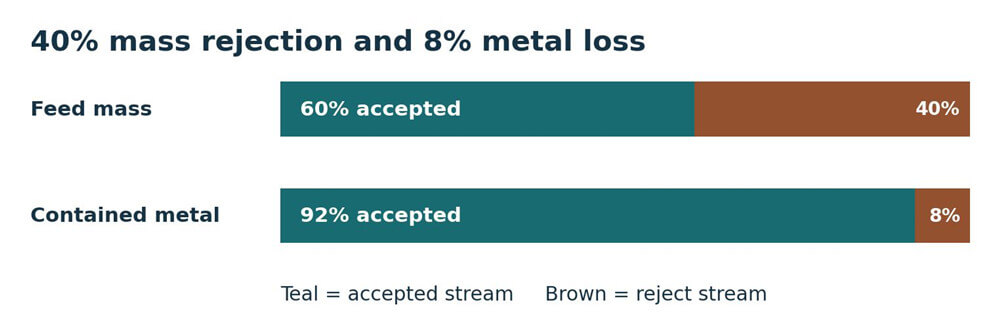
For example, suppose 100 tonnes of sorter feed assay 1.0% of the target metal. If the sorter rejects 40 tonnes assaying 0.2%, the accepted 60 tonnes grade about 1.53% and retain 92% of the metal entering the sorter. The grade upgrade is substantial, but the reject still contains 8% of the feed metal. Whether that trade-off makes sense depends on downstream recovery, milling costs and the value of the lost metal. These figures illustrate the calculation and represent a hypothetical test.
Limitation 4: The Complexity of The Ore Composition is Prone to Causing Identification Errors.
Complex ore composition makes classification less reliable. Ores often contain several minerals within a single rock, and their proportions can change across a deposit. An XRT image records the combined attenuation along the path through that rock. Different mineral assemblages can therefore produce similar signals. A dense gangue mineral may cause barren particles to resemble ore, while a small vein of valuable material within a larger piece of host rock may produce a weak response. Particle thickness, shape and orientation can also change how the same material appears. Dual-energy XRT can help account for thickness effects, although overlap between ore types may still limit separation.
A calibration developed on fresh ore from one mining area can perform differently on weathered or blended feed if the distribution of minerals changes. Test samples should represent the ore domains and blends the plant expects to process. Assays and mineralogical checks on misclassified material can reveal whether the problem comes from a particular gangue mineral, low levels of mineralisation or changing feed conditions. More representative training data and better classification algorithms can improve how the sorter uses the signal. Their value depends on whether the sensor can consistently detect a difference between the particles the plant wants to separate.
Limitation 5: There is Limited Adaptability for Sorting Complex Ores Containing Associated or Co-occurring Minerals.
Associated valuable minerals can require other processes. XRT sorts whole particles. When two valuable minerals are locked within the same particle, the sorter sends both to the same stream. A particle may also contain a payable by-product at a grade that contributes little to the transmission signal. For example, a threshold calibrated to retain strongly attenuating ore could discard particles that carry a different payable mineral in a weakly attenuating host. For polymetallic ores, evaluate recovery for each payable element before sending a reject stream to waste.
Depending on the mineralogy, it may be practical to reject barren rock with a distinct XRT signal at the coarse stage and then grind the accepted stream to liberate the valuable minerals. Gravity concentration, magnetic separation or flotation can then recover minerals that respond to different physical or surface properties. Multi-sensor sorting may also help when a second sensor provides a measurable signal associated with a mineral that XRT struggles to detect. For example, a surface-sensitive sensor may add information where the target mineral is commonly exposed. The benefit depends on the ore and comes with additional calibration and maintenance, so the combined system should be validated on representative feed.
A separate decision concerns how the sorter fits into an existing plant. A circuit that starts with a crusher and screen may already have a suitable sorting fraction. If it needs a new crushing stage, weigh the cost and additional fines against the amount of material the sorter can divert. At a mill constrained by grinding capacity, removing waste may free up capacity for additional ore. At a plant with spare milling capacity, the case may depend more heavily on operating savings and the value of any metal lost in the reject.
Conclusion
X-ray sorting machines are a good candidate for pre-concentration when the ore contains a meaningful share of coarse waste that can be removed at an acceptable metal loss. Compare grade improvement, mass rejection and recovery at a realistic throughput, then account for bypassed fines, feed preparation, compressed air and reject handling. If early rejection reduces the tonnage sent to grinding, the plant may use less grinding energy and produce less mill tailings per tonne of ore mined. The sorter reject still needs to be included in the site’s waste plan. For more on the operating benefits of early waste rejection, see What Are The Advantages of XRT Intelligent Pre-sorting Process Technology?
Advances in classification, particle tracking and air-jet control can improve the consistency of detection and ejection. Better feed presentation can extend the usable operating range, and combining sensors may help distinguish some complex ores. For a specific project, representative testwork remains the basis for sizing and selecting equipment. Start by measuring the grade and mass distribution by size fraction. Then test the most promising fractions at realistic feed rates, assay both output streams for every payable element and compare the results with the existing flowsheet. Those measurements show whether the sorter can reject enough waste to justify the cost and the associated recovery loss.