Mining operations often face inefficiencies in ore processing – poor sorting accuracy, wasted resources, and high operational costs. Traditional methods simply can’t keep up with modern mining demands. XRT intelligent pre-sorting technology changes this completely, offering scientific, objective sorting with remarkable efficiency.
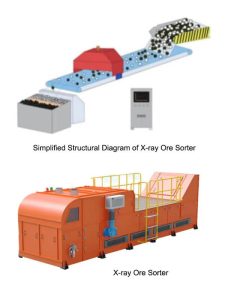
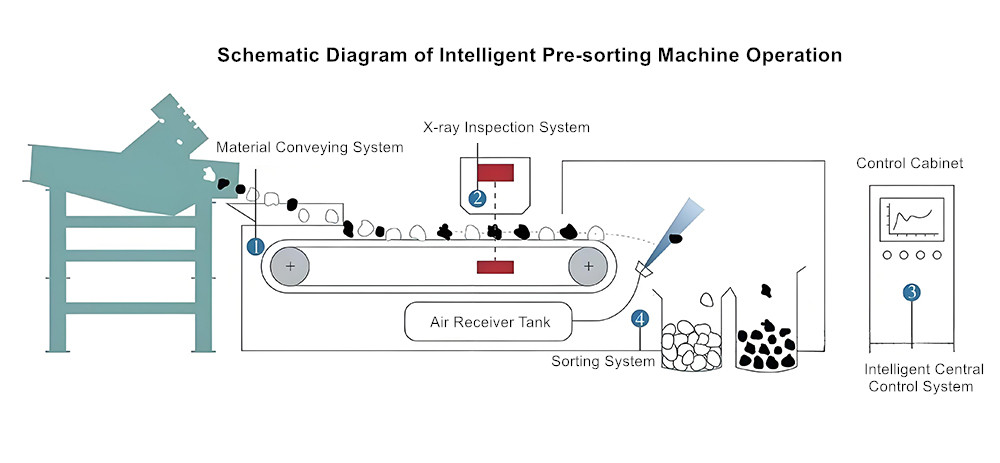
XRT intelligent pre-sorting combines X-ray transmission technology with advanced algorithms to achieve precise, automated mineral identification and separation. Unlike traditional methods, it examines the entire rock volume, identifies multiple mineral types simultaneously, and adapts to different ore characteristics – delivering comprehensive advantages in accuracy, efficiency and environmental performance.
Most mines still rely on outdated sorting methods that waste valuable resources. XRT technology represents a revolutionary leap forward, delivering results that manual sorting or basic physical separation methods could never achieve. Its intelligent operation transforms how we process minerals at the pre-sorting stage. In the last article, we introduced “What is XRT Intelligent Sorting Technology?“; next, we will introduce its advantages.
1. High Efficiency and Accuracy in Ore Processing
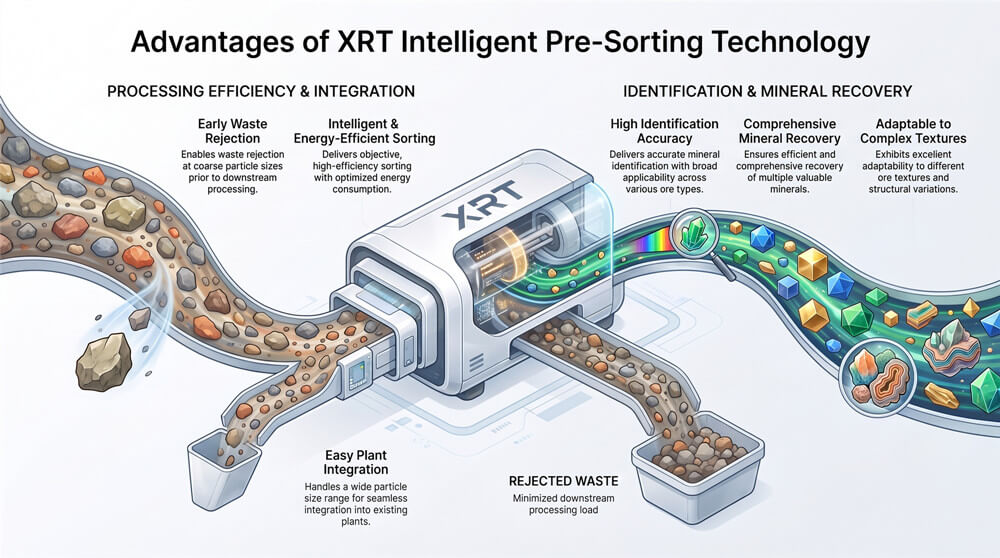
(1) Intelligent, Objective, and Energy-Efficient Sorting
XRT intelligent pre-sorting integrates scientific detection, automated identification, intelligent control, energy efficiency, and environmental protection into a single process. Compared with traditional manual sorting, which is labor-intensive, inefficient, and susceptible to subjective judgment, XRT provides more consistent sorting performance and greater operational reliability.
The technology also offers excellent adaptability, allowing the cutoff grade for valuable components to be adjusted according to ore characteristics, production requirements, and economic objectives. Compared with conventional gravity and magnetic separation, XRT provides advantages in early waste rejection, sorting precision, intelligent process control, equipment adaptability, and the dynamic adjustment of sorting parameters. Its dry sorting process can also reduce water consumption and help improve workplace safety and environmental performance.
(2) High Mineral Identification Accuracy and Broad Ore Applicability
Traditional pre-sorting methods, such as gravity separation, magnetic separation, and color sorting, primarily rely on individual physical properties, including density, magnetic susceptibility, and color. Their effectiveness may be limited when valuable minerals and gangue exhibit similar physical characteristics.
XRT technology uses X-ray transmission imaging to identify differences in the internal attenuation characteristics of ore particles, enabling the system to locate and distinguish target-bearing particles with high precision. Because the identification process is not limited to surface color or magnetic properties alone, XRT can be applied to a wide variety of ore types, provided that sufficient differences in X-ray attenuation exist between the valuable minerals and gangue.
This capability makes XRT a versatile solution for improving ore sorting performance and reducing the dependence on conventional physical separation methods.
(3) Comprehensive Recovery of Multiple Valuable Minerals
XRT intelligent pre-sorting can identify and enrich multiple valuable mineral-bearing particles within the same sorting process, provided that their X-ray characteristics, particle size, liberation conditions, and economic value support effective separation. This capability helps reduce the loss of valuable components during waste rejection and improves the comprehensive utilization of mineral resources.
For example, during magnetic pre-sorting of magnetite ores or gravity-based waste rejection in tungsten and tin ores, valuable minerals that are insufficiently liberated or have unfavorable separation characteristics may be lost with the discarded material. XRT can help recover some of these valuable mineral-bearing particles, complementing conventional separation processes.
For tungsten-tin ores containing both valuable metallic minerals, such as copper, lead, and zinc minerals, and economically valuable non-metallic minerals, such as quartz, a two-stage intelligent sorting strategy may be considered. The first stage uses XRT to enrich valuable metallic mineral-bearing particles, while the second stage employs color sorting or another suitable intelligent sorting method to recover the target non-metallic minerals.
By integrating different sorting technologies according to mineral characteristics, processing plants can improve overall resource recovery and maximize the economic value of complex ores.
(4) Excellent Adaptability to Different Ore Textures and Structures
The sorting performance of XRT is strongly influenced by ore occurrence, mineral distribution, texture, structure, and the degree of liberation after crushing.
XRT is particularly suitable for deposits in which valuable minerals occur in veins, layers, or other clearly defined geological structures, such as many tungsten, tin, and antimony ores. The distinct boundaries between mineralized material and waste rock make it easier to identify and reject barren particles, potentially achieving high waste rejection rates while maintaining low valuable-metal losses.
For ores with continuously varying mineralization or uniformly disseminated mineral particles, such as porphyry copper ores, the contrast between valuable minerals and gangue may be less distinct. Consequently, the achievable waste rejection rate may be lower. Nevertheless, XRT can still help identify and remove waste rock introduced during mining, especially when the surrounding rock differs sufficiently from the mineralized material in its X-ray attenuation characteristics.
For ores with irregularly distributed mineralization, ranging from sparse to dense dissemination, sorting performance generally falls between these two extremes. Therefore, representative ore testing and process evaluation are essential for determining the expected sorting efficiency and economic benefits.
(5) Wide Particle Size Range and Easy Integration into Existing Plants
XRT sorting equipment can handle a relatively broad particle size range, typically from approximately 5 mm to 150 mm, depending on equipment configuration and ore characteristics. This flexibility facilitates integration into existing crushing and grinding circuits while minimizing disruption to the original production process.
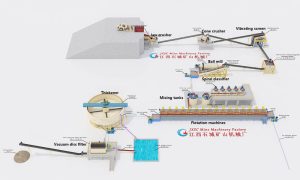
The technology can be applied to suitable screening products in conventional three-stage closed-circuit crushing plants, intermediate and oversize fractions from two-stage closed-circuit crushing circuits, and pebbles generated by semi-autogenous grinding (SAG) or autogenous grinding (AG) circuits.
As a result, introducing XRT pre-sorting into an existing crushing or grinding system may require only limited modifications and, in suitable cases, no additional screening operation beyond the existing circuit configuration.
For medium- and large-scale mines using multiple sorting machines, narrow-size-range parallel sorting is generally recommended. This approach helps improve material distribution, particle presentation, and air-jet ejection accuracy, thereby enhancing overall sorting performance and system stability.
(6) Early Waste Rejection at Coarse Particle Sizes
One of the most important advantages of XRT technology is its ability to reject waste rock at relatively coarse particle sizes, in line with the mineral processing principle of “rejecting waste early and rejecting as much waste as possible.”
Reducing waste material before fine crushing and grinding decreases the volume of material that must be processed in downstream operations. This can lower energy consumption, reduce equipment wear, increase effective plant capacity, and improve the feed grade of subsequent beneficiation processes.
Although magnetic pre-sorting of magnetite can sometimes be integrated directly after coarse crushing, conventional gravity and magnetic waste rejection for many other non-coal ores is generally limited to finer particle sizes. XRT can often process material at sizes comparable to the upper particle-size range of intermediate crushing products in conventional three-stage closed-circuit crushing systems.
This makes XRT particularly valuable for early-stage waste rejection, where removing barren material can deliver substantial savings throughout the entire processing plant.
(7) Advantages of XRT over XRF-Based Sorting
XRT and X-ray fluorescence (XRF) sorting use different detection principles. XRT relies on X-ray transmission imaging to assess the attenuation of X-rays as they pass through ore particles, providing information related to their internal composition and density distribution. XRF, by contrast, detects characteristic X-rays emitted from the irradiated material and is primarily used to analyze elemental composition near the exposed surface under typical sorting conditions.
Because XRT evaluates transmitted X-ray signals through the particle, it can provide information about internal material differences that may not be adequately represented by surface measurements alone. This can be advantageous when sorting coarse particles with heterogeneous internal structures.
XRT is therefore a well-established option for intelligent ore pre-sorting, particularly where internal attenuation contrasts provide sufficient discrimination between valuable mineral-bearing particles and waste rock. However, the optimal choice between XRT and XRF depends on the target elements or minerals, ore composition, particle size, required detection sensitivity, and economic feasibility. Neither method is universally superior for every ore type.
2.Efficient and Comprehensive Recovery of Multiple Valuable Minerals
Significant losses of metallic mineral resources often occur during mining operations, particularly during overburden removal and the stockpiling of off-grade ore. Intelligent sorting technology offers an effective solution; it enables economical processing of marginal-grade ore blocks and improves the feed grade of industrial-grade ore by pre-rejecting waste rock. This technology typically requires the ore to be crushed (via primary and secondary stages) to a suitable particle size beforehand.
For instance, some copper concentrators have installed intelligent sorting equipment upstream of autogenous (AG) mills to separate low-grade waste rock. This approach has yielded significant benefits—such as reduced mill throughput and lower grinding energy consumption—demonstrating the technology’s substantial potential.
Common ore pre-sorting workflows include the following three types:
① Direct pre-sorting: This process is suitable for ores with a relatively uniform particle size distribution and low content of fines or powdered ore; the material enters the sorting equipment directly after simple feeding and leveling.
② Screening–pre-sorting combined process: The ore undergoes screening to remove excessively fine particles, and the oversize fraction is then fed into the intelligent sorting system.
③ Closed-circuit crushing–screening–pre-sorting process: After crushing and screening, material that does not meet size specifications is returned to the crusher for further size reduction, while material within the acceptable size range proceeds to the pre-sorting equipment, creating a closed-loop system.
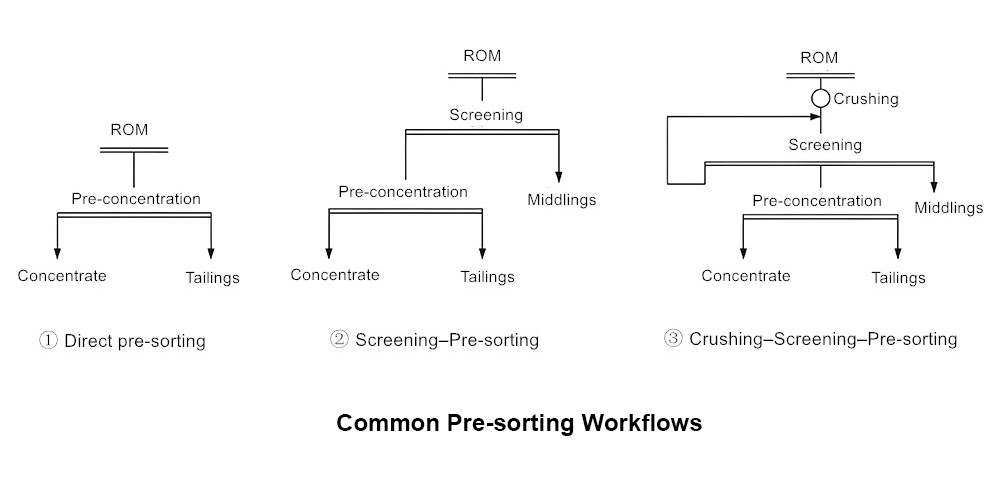
In practical applications, the choice of workflow requires a comprehensive assessment of ore properties, particle size distribution, and economic factors to fully leverage the technical advantages of intelligent sorting and enhance the flexibility of the overall process.
Conclusion
XRT intelligent pre-sorting technology offers significant advantages in ore identification accuracy, coarse-particle waste rejection, multi-mineral resource recovery, and integration with existing mineral processing circuits. By removing waste rock before fine crushing and grinding, it can reduce the amount of material requiring downstream treatment, lower energy and water consumption where applicable, improve feed grade, and enhance overall resource utilization.
Its performance, however, depends on the mineralogical characteristics of the ore, the contrast in X-ray attenuation between valuable material and gangue, particle size, liberation conditions, and process economics. Appropriate ore testing and flowsheet design are therefore essential to achieving reliable and cost-effective results.
When these factors are properly evaluated, XRT intelligent pre-sorting can serve as an effective component of modern mineral processing systems, supporting more efficient resource recovery, lower operating costs, and more sustainable mining operations.