Gravity separation of manganese ore leverages the significant density contrast between manganese minerals (4.5–5.2 g/cm³) and gangue minerals (e.g., quartz, calcite, 2.6–2.7 g/cm³). This method is particularly effective for oxidized manganese ores with simple structures, coarse dissemination, and fully liberated minerals. Unlike crude single-device setups, modern gravity separation processes excel by first precisely classifying the feed into optimal size fractions, then assigning each fraction to specialized equipment such as jigs and shaking tables. This eliminates common issues such as interference from mixed-size particles or increased pulp viscosity due to slimes, ultimately boosting both concentrate grade and metal recovery.
Scientific Particle Size Segmentation: The Prerequisite for Efficient Gravity Separation
The core of particle size segmentation lies in precisely dividing the crushed ore into four distinct size fractions based on the optimal sorting ranges of different gravity separation equipment, thereby creating optimal sorting conditions for subsequent equipment right from the source:
- Coarse Fraction (6–30 mm): This is the optimal range for jig separation. Particles in this size class exhibit the most significant differences in settling velocity, allowing for the direct removal of a large amount of individual gangue and waste rock, thereby significantly reducing the workload of subsequent operations.
- Medium-grain size range (0.5–6 mm): This falls within the lower limit of effective separation for jigging machines and can also be used in conjunction with spiral chutes for pre-enrichment, balancing throughput and separation accuracy.
- Fine-grain size range (0.074–5 mm): This is the core range for shaking table separation. The lateral and longitudinal separation of materials in this size range is most pronounced on the shaking table surface, allowing for the direct production of qualified, high-grade concentrate.
- Ultrafine fraction (-0.074 mm): Conventional jigging and shaking tables cannot achieve effective separation for this fraction. It requires separate desliming followed by processes such as strong magnetic separation to recover the material, thereby preventing fine slime from contaminating the main process.
For classification operations, a “double-deck vibrating screen + hydrocyclones” configuration should be used, with screen mesh sizes set at 30 mm and 6 mm, respectively. Material larger than 30 mm is returned to the crushing system to form a closed-circuit process, ensuring that the particle size of the material entering the gravity separation process is fully controlled.
Jig Separator: The Core Component for High-Efficiency Pre-concentration in the Coarse-Grain Stage
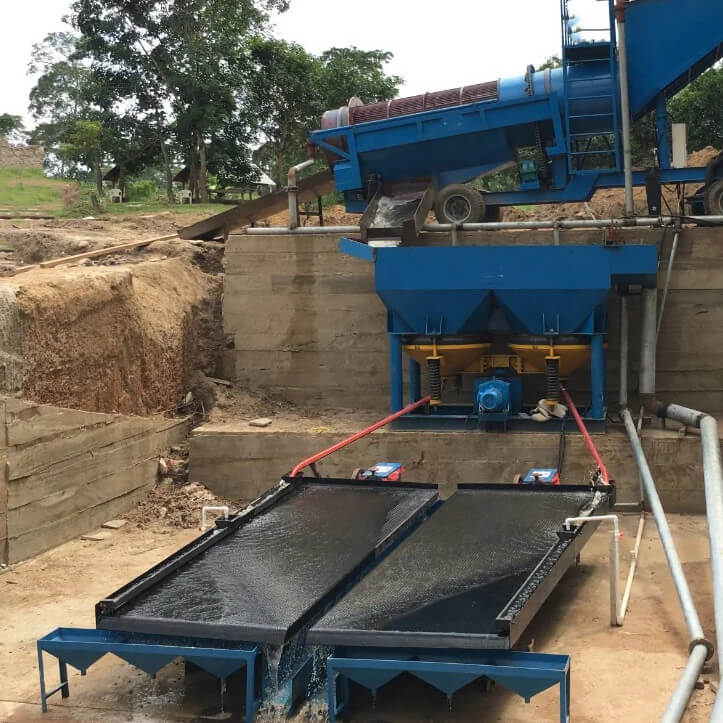
The jig separator utilizes a vertical, alternating pulsating water flow to cause the bed to periodically loosen and settle, allowing high-density manganese minerals to rapidly sink to the bottom of the bed while low-density gangue remains suspended in the upper layer. The product is then separately recovered via a dedicated discharge device, making it the equipment of choice for the gravity separation of coarse-grain manganese ore.
Equipment Selection and Adaptation
Small and medium-sized manganese ore processing plants in China generally use side-acting diaphragm jigs and bottom-acting conical jigs. The sawtooth-wave jigs, which have been promoted in recent years, feature a pulsation curve better suited for manganese ore separation and offer a 15%–25% increase in processing capacity compared to traditional equipment. Large-scale processing plants (with a throughput of ≥50 t/h) should prioritize the JT series of high-capacity jigging machines, while small-scale plants may opt for the LTA series or the AM-30 model.
Coordinated Control of Key Parameters
Maintain the feed concentration at a stable level between 20% and 40%. For large ore chunks, the concentration may be appropriately increased, while fine-particle slurry must be diluted in advance. Stroke length and stroke frequency must be matched to the feed particle size: use a long stroke and low frequency for coarse grades, and a short stroke and high frequency for fine grades, to prevent ore loss in the tailings caused by parameter mismatches.
Core Requirements for Tailings Verification
The grade of jigging tailings cannot be determined solely by appearance; regular sampling and sieve analysis are mandatory. If the proportion of manganese minerals in the +6 mm size fraction of the tailings is abnormally high, immediately investigate potential issues such as damage to the classification screens or blockage of the jig bed plates to prevent irreversible loss of coarse manganese minerals.
Shaking Table: The Key to Precise Concentration of Fine-Grained Material
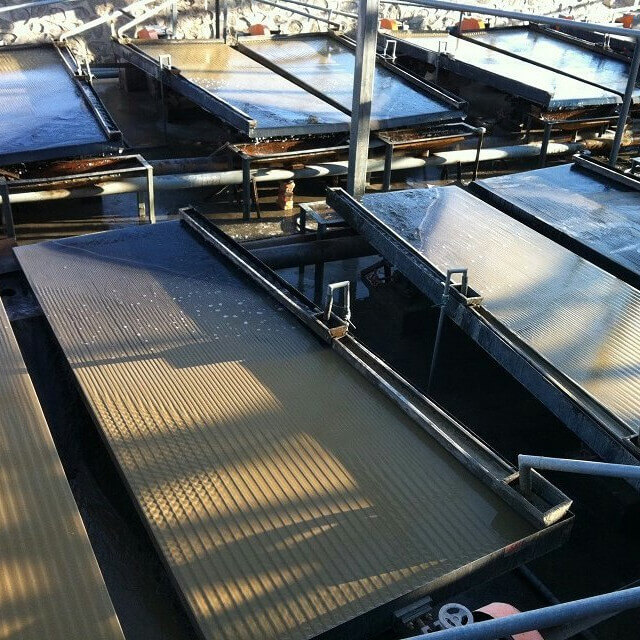
The shaking table relies on the synergistic effect of the bed’s reciprocating differential motion and transverse flushing water to cause mineral particles of different densities and particle sizes to move in distinct longitudinal and transverse patterns across the bed surface. The particles are ultimately discharged in fan-shaped zones, directly producing final concentrate, intermediate product, and tailings. It is the core equipment for the concentration of fine-grained manganese ore.
Deck Customization
- For processing coarse sand-sized material(0.5–2 mm), a rubber-grooved bed surface is selected with a longitudinal slope of 1°–2°;
- For processing fine sand-sized material(0.074–5 mm), a lacquer-gray grooved bed surface is selected with a longitudinal slope adjusted to approximately 0.5°, to accommodate the stratified flow characteristics of different particle sizes.
Precise Control of Operating Parameters
Feed concentration must be strictly maintained between 15% and 30%. Visually monitor the bed surface to ensure clear demarcation of the three zones—”concentrate zone, intermediate zone, and tailings zone.” If the boundaries between zones are blurred, immediately adjust the concentration: excessively high concentration causes the slurry to cover the bed surface and leads to mineral mixing, while excessively low concentration significantly reduces the equipment’s throughput and increases water costs. At the same time, the rinse water volume must be precisely matched; insufficient water will result in incomplete removal of light minerals, while excessive water will cause fine-grained manganese minerals to be flushed into the tailings and lost.
Precise Zone Management
By adjusting the uniformity of feed at the feed end and the stroke and frequency parameters, the boundaries between the concentrate zone, intermediate zone, and tailings zone can be made distinct, enabling the direct production of final manganese concentrate that meets grade requirements without the need for additional beneficiation operations.
Pre-treatment: Ore Washing and Desliming to Establish a Stable Foundation for Separation
For severely weathered manganese oxide ore with high clay content, it is absolutely essential not to directly apply conventional coarse-grain gravity separation processes; a complete ore washing and de-silting operation must be completed prior to gravity separation:
A combination of drum washers and trough washers is employed. Through mechanical scrubbing and high-pressure water jet impact, clay agglomerates within the ore are thoroughly broken down, preventing clay from encapsulating manganese minerals and affecting subsequent separation.
The ore slurry is then graded using a vibrating screen to pre-separate fine silt (-0.074 mm). If necessary, hydrocyclones and thickeners are deployed to stabilize the concentration of slurry across all particle size fractions. This eliminates interference from fine silt in jigging and shaking table separation at the front end, creating stable operating conditions for subsequent gravity separation.
Full-Process Particle Size Verification: A Core Method for Process Commissioning and Optimization
During the commissioning phase of a gravity separation process, it is essential to simultaneously conduct full-grain-size sieve analysis and manganese grade distribution testing on the three products—concentrate, intermediate product, and tailings—to accurately identify process weaknesses:
- If the proportion of coarse manganese minerals (>6 mm) in the tailings is abnormally high, prioritize checking whether the upstream classification screens are damaged and whether the jig stroke and frequency parameters are appropriate, and promptly adjust the separation conditions for the coarse fraction.
- If manganese metal loss in the fine slime exceeds 15%, recalibrate the size cut-off point for the desliming operation while simultaneously adjusting the shaker’s rinse water flow rate and the transverse slope of the bed surface to minimize carryover loss of fine-grained manganese minerals.
- The final number of equipment units and the number of process stages (a combination of roughing, concentrating, and scavenging) must be determined based on actual mineral processing test results, taking into account the plant’s processing capacity and the ore’s distribution characteristics, to avoid failing to meet performance targets due to blindly replicating generic processes.
This jig-shaking table combined gravity separation process, with its advantages of a simple flow sheet, low operation and maintenance costs, and no chemical pollution, has been widely adopted in major domestic manganese-producing regions such as Guangxi, Hunan, and Yunnan, as well as in overseas manganese processing plants in Namibia and South Africa. For coarsely disseminated manganese oxide ores, it can achieve a manganese concentrate grade of over 40% and metal recovery rates exceeding 85%. It is currently the most technically mature and economically optimal mainstream process route in the field of manganese ore gravity separation.