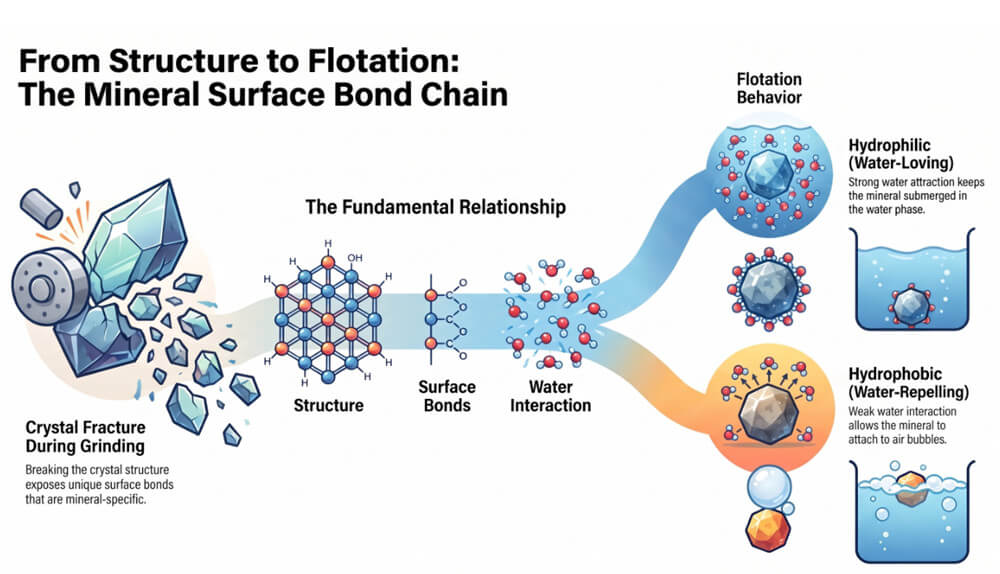
Mineral flotation is strongly influenced by crystal structure and the type of chemical bonds exposed on a mineral surface. When a mineral is crushed or ground, its crystal lattice is broken and new surfaces are created. These surfaces may expose ionic bonds, covalent bonds, metallic bonds, or weaker molecular forces, which determine how strongly water interacts with the mineral. In general, hydrophilic surfaces have poor natural floatability, while hydrophobic surfaces are more favorable for flotation. However, natural wettability is only part of the story: in practical mineral processing, the interaction between the mineral surface and a flotation collector is often the decisive factor.
Crystal Structure Determines the Bonds Exposed at the Surface
Minerals have different crystal structures because their atoms, ions, or molecules are arranged and bonded in different ways. When the crystal is fractured during grinding, the bonds exposed on the newly created surface are not necessarily the same for every mineral.
This creates a fundamental relationship:
Crystal structure → surface bonds → water interaction → surface wettability → flotation behavior
If the exposed surface strongly attracts water molecules, it becomes hydrophilic and tends to remain in the water phase. If the surface interacts weakly with water, it becomes hydrophobic and is more likely to attach to air bubbles.
Therefore, understanding the surface bonds created by mineral fracture is essential for explaining mineral floatability.
Paraffin: Molecular Forces Create Natural Hydrophobicity
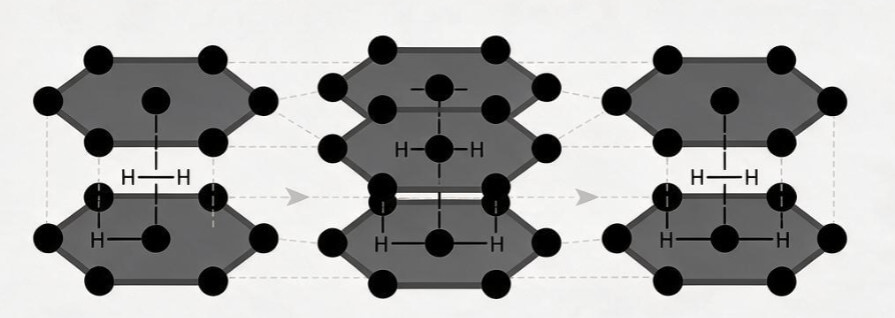
Paraffin is a natural organic hydrocarbon with the general formula CₙH₂ₙ₊₂. Unlike minerals dominated by ionic or extended covalent networks, paraffin has a molecular crystal structure.
The molecules are held together mainly by relatively weak intermolecular forces, particularly dispersion forces. These forces interact only weakly with water molecules, so water does not readily form a strongly oriented layer around the paraffin surface.
As a result, paraffin has low water affinity, strong hydrophobicity, and good natural floatability.
This example demonstrates how a surface dominated by weak molecular forces can naturally resist wetting by water.
Graphite: Layered Structure Produces a Hydrophobic Basal Surface
Graphite is another classic example of the relationship between crystal structure and natural floatability.
Its carbon atoms form hexagonal layers. Within each layer, carbon atoms are connected by strong covalent bonds, whereas adjacent layers are held together by much weaker intermolecular forces.
When graphite is crushed, it tends to break along these weakly bonded planes, producing thin flakes. The large basal surfaces are dominated by weak intermolecular interactions and are relatively hydrophobic. Although freshly broken edges contain unsatisfied covalent bonds and can interact more strongly with water, these edge areas are much smaller than the basal surfaces.
Therefore, the overall graphite particle remains sufficiently hydrophobic to exhibit good natural floatability.
Mica: Why Not All Layered Minerals Float Naturally
A layered crystal structure does not automatically mean that a mineral is hydrophobic.
Mica, for example, also has prominent cleavage planes, but its exposed surfaces have different chemical and electrostatic properties. These surfaces can interact strongly with water and are therefore relatively hydrophilic.
This comparison shows that crystal structure alone cannot predict floatability. The chemical nature and bonding characteristics of the exposed surface must also be considered.
Quartz: Covalent Bonds Produce Hydrophilic Fresh Surfaces
Quartz is one of the most common gangue minerals in mineral processing. Its crystal structure is very different from the layered structure of graphite.
Quartz consists of interconnected SiO₄ tetrahedra forming a three-dimensional framework. During crushing and grinding, Si–O bonds are broken and chemically active sites are generated on the fresh surface.
These surface sites interact strongly with water. Freshly fractured quartz surfaces can undergo surface reactions involving hydroxyl species, contributing to their hydrophilic character.
Consequently, quartz has poor natural floatability.
However, quartz can still be effectively floated after treatment with appropriate flotation reagents. This illustrates an important principle: poor natural floatability does not mean that a mineral cannot be floated.
Sulfide Minerals: Surface Reactivity Enables Collector-Induced Flotation
Metal sulfide minerals, such as galena (PbS), have bonding characteristics that can include covalent and metallic components. Freshly fractured sulfide surfaces may interact with water and therefore do not necessarily have strong natural hydrophobicity.
Their major advantage in flotation is their surface reactivity.
Sulfide mineral surfaces can interact readily with oxygen and organic flotation reagents.
Appropriate collectors can adsorb onto these surfaces and change their wettability, making the mineral more hydrophobic and promoting attachment to air bubbles.
Thus, the flotation of sulfide minerals depends less on inherent natural hydrophobicity and more on the ability of their surfaces to interact selectively with flotation collectors.
How Surface Bonds Affect Mineral Wettability?
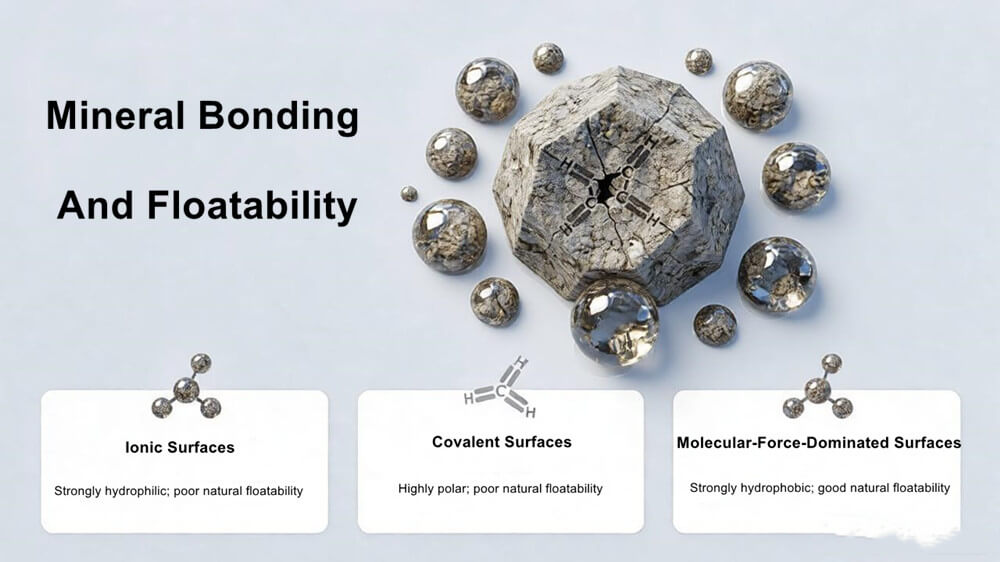
The major surface-bonding categories help explain why different minerals show different flotation responses.
Ionic Surfaces
Mineral surfaces dominated by ionic interactions generally have strong electrostatic interactions with water. Minerals such as calcite and fluorite are typically hydrophilic and have poor natural floatability.
In flotation, collectors are therefore required to modify the surface and increase its hydrophobicity.
Covalent Surfaces
Covalent bonds have relatively high bond energies. Freshly fractured covalent minerals such as quartz can expose chemically active surface sites that interact strongly with water.
Such surfaces are generally hydrophilic and require suitable reagents to achieve effective flotation.
Molecular-Force-Dominated Surfaces
Surfaces dominated by weak molecular forces, particularly dispersion forces, tend to interact weakly with water and can therefore be strongly hydrophobic.
Paraffin and the basal planes of graphite are representative examples. Molybdenite (MoS₂) and pyrophyllite also have structural features that can contribute to natural floatability.
Why Collectors Are Critical in Practical Flotation?
Although crystal structure provides the foundation for understanding mineral wettability, flotation performance cannot be predicted from natural hydrophobicity alone.
In industrial flotation, collectors are used to selectively modify mineral surfaces. A collector may adsorb onto a particular mineral and make its surface more hydrophobic, allowing it to attach to air bubbles and enter the froth phase.
Therefore, the practical flotation response depends on several factors, including:
- Crystal structure and surface bonding
- Mineral composition
- Fresh surface generation during grinding
- Surface oxidation and hydration
- Pulp pH and chemical conditions
- Collector adsorption
- Interaction with other flotation reagents
- Particle size and mineral liberation
The key question is not simply whether a mineral is naturally hydrophobic, but whether its surface can interact selectively with a collector under flotation conditions.
Conclusion: Surface Bonds Connect Crystal Structure to Flotation
The effect of crystal structure on mineral flotation can be summarized as:
Crystal structure → fracture surface → exposed bonds → water interaction → wettability → collector adsorption → flotation response
Minerals such as paraffin and graphite demonstrate how molecular-force-dominated surfaces can produce natural hydrophobicity and good floatability. Quartz shows how a three-dimensional covalent structure can generate hydrophilic fresh surfaces, while sulfide minerals demonstrate the importance of surface reactivity toward collectors.
Ultimately, crystal structure influences flotation by determining which bonds and chemical groups are exposed on the mineral surface. These surface characteristics control the initial interaction with water and determine how the mineral responds to flotation reagents. For this reason, understanding surface bonds, wettability, and collector adsorption is fundamental to explaining and optimizing mineral flotation.